
AI Agents at Work: What They're Actually Doing in Your Operations
Only Have a Minute? Here Are the Key Takeaways:
AI agents thrive in the work between your systems. That includes the emails, spreadsheets, and manual coordination that still run your most time-sensitive operations.
Three modes define how agents operate. They can gather information, surface risks to support better decisions and execute tasks within guardrails you set.
Real examples are already running. Traceability audits can be carried out in minutes instead of hours. Inbound purchase orders can be validated and processed without manual handling. Transport disruptions can be triaged before customers feel the impact.
Agents don't replace your team's judgment. They replace the coordination work that gets in the way of it.
Fragmented ownership is the most common reason AI initiatives stall. Someone needs to own the outcome end-to-end, not just the model.
You don't need to build AI infrastructure or hire data scientists. Aptean Intelligence as a Service designs, builds, and manages purpose-built agents on your existing data and workflows.
Wednesday 8 July 2026
6 min

By Aptean Staff Writer
Share this report
Featured in this post
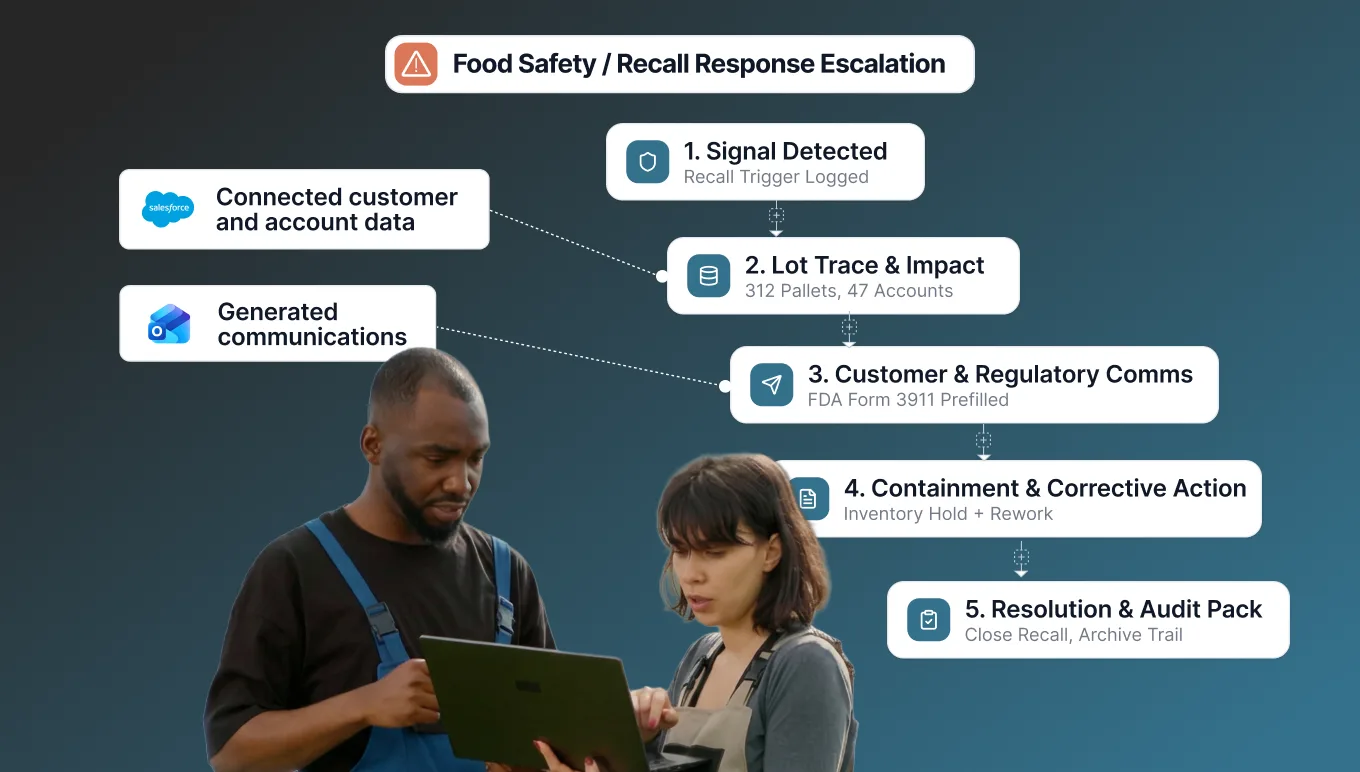
If you've read our first post in this series, you came away understanding what artificial intelligence (AI) agents are and why they belong in your operations. You understand that your enterprise resource planning (ERP) system (or other core business solution) is your system of record, and that AI agents are your system of action, designed to act on the data your systems already hold.
The first follow-up question most operations leaders have is more specific: What does that actually look like? Which processes should we target? Which teams should be involved? What changes day-to-day?
That's what this post is about.
Most operations are regularly paying costs that don’t show up on any report. They include the time spent managing data that lives between your systems: the emails carrying purchase orders, the spreadsheets tracking what no system quite captures, the manual coordination that happens when a delay lands in someone's inbox. This is the connective tissue of operations, and it's where time, accuracy and energy quietly bleed out every day.
AI agents are built for exactly this environment. They're not designed to replace your core operational system or the structured workflows it supports. They're designed to handle what happens around it—monitoring, gathering, triaging, coordinating, and acting—continuously, at a scale no team can match manually.
Here's a practical look at how that plays out.
The Work Agents Are Built For
Think about the last time someone on your team had to prepare a traceability response for an auditor or retail customer. They probably opened four or five systems, collected batch records, quality assurance (QA) documents, supplier certificates, and transportation logs, then assembled everything by hand. What seems fairly simple routinely takes hours.
Consider what happens when a transportation delay ripples through your network. Someone has to identify affected customers, recalculate expected delivery times, draft proactive communications and update downstream plans. That’s typically done through a combination of email, phone calls and individual decisions. The work is time-sensitive, and it's still almost entirely manual.
These are the processes where agents deliver the fastest, clearest value: high-friction work that's structured enough to automate but complex enough that it's never been fully systematised. And because this kind of work is common across manufacturing, logistics, and equipment dealership organisations, this isn't an industry-specific problem; it's an operational one.
Three Ways Agents Operate
The most useful frame for understanding agent capabilities isn't about the technology—it's about what agents actually do. Most agents operate in one of three modes, and the strongest ones combine all three.
Gather and Connect
The simplest (and often most immediately valuable) thing an agent can do is bring together information that already exists across multiple systems and surface it in the right context at the right time.
A traceability agent, for example, can take a batch number or product code and assemble a complete audit response—batch records, QA inspections, supplier certificates, production data and transport logs—in minutes rather than hours. That's not an incremental improvement. It's a fundamental change in how your team allocates its time.
A transport visibility agent operates on the same principle: pulling together shipment updates, warehouse loading status, driver tracking data and customer delivery schedules into a live operational picture. Now, your coordinators stop chasing information across systems and start acting on it.
Decide and Flag
Decision support agents don't execute tasks directly. They surface the patterns, risks and anomalies your team needs to know about before small issues become large ones.
An inventory monitoring agent, for example, can identify slow-moving stock, ageing products, first-expired-first-out (FEFO) conflicts, and short shelf-life risks to flag potential financial or compliance exposure before it costs you. A production exception agent monitors downtime trends, yield variances, and material usage anomalies at the shift level, so supervisors have the context to act rather than react.
In both cases, the agent isn't making the decision. It's making sure the right person has the right information in time to make a better one.
Execute With Guardrails
Execution agents take action within defined parameters and escalate the exceptions that genuinely require human judgment.
A sales order processing agent reads inbound customer purchase orders, validates pricing rules, checks inventory availability, creates the order in your core business system and routes exceptions for approval—all without manual intervention. Your team's attention shifts from routine processing to the cases that actually need it.
A transportation disruption agent works the same way: When delays occur, it identifies affected customers, generates revised estimated arrival times, triggers proactive notifications and updates routing workflows. Your customer service team receives a clear picture of the situation rather than a problem to diagnose.
The Hardest Part Isn't Building the Agent
If you've watched an AI initiative lose momentum, you've probably seen it happen shortly after the pilot. The model works, and the proof of concept delivers. Then the agent goes live, and ownership fragments.
The consultant who built it moves on. The IT team hosting it doesn't own the business logic. The technology provider manages the system of record, not the agent sitting in front of it. When the process evolves, or the data structure changes, or new exceptions emerge, nobody's clearly accountable for keeping the agent current. So confidence declines, and the initiative stalls.
This is why agents need the same governance structure as any operational process: defined ownership, clear performance metrics, a feedback loop, and someone accountable for the outcome. The metrics worth tracking aren't abstract: touches per transaction, cycle time, first-pass order accuracy, exception rate, and on-time-in-full are all familiar. If you baseline them before deployment, you can prove the impact and know when something needs adjustment.
This is also where Aptean Intelligence as a Service (AIaaS) changes the dynamic. Rather than treating AI as a technology project for your IT team, AIaaS makes it an operational outcome that Aptean owns end-to-end.
Aptean designs, builds, deploys and continuously manages purpose-built agents on the data and workflows you already run. No heavy integration work upfront, and no new infrastructure to stand up.
And because Aptean already understands your industry's operational workflows, compliance requirements and data structures, the time from initial discovery to a live agent is weeks, not months. What’s more, Aptean manages and optimises your agents over time, they improve as your operations evolve rather than going stale six months after go-live.
You bring the business problems and the operational expertise. Aptean brings the industry knowledge, the AI capabilities, and the end-to-end ownership that most AI initiatives lack.
If you're ready to identify where an AI agent could start creating value in your operations, contact us today. You can also schedule a personalised demo at your convenience.
To learn more about AI and how Aptean’s next-generation solutions are setting a new standard in enterprise software, explore the Aptean AI Academy, featuring live and on-demand sessions with our experts.

By Aptean Staff Writer
Related Content
Biggest AI Adoption Challenges and How To Overcome Them
Explore the biggest challenges organizations face when adopting artificial intelligence and learn practical ways businesses can overcome barriers to successful AI implementation.

AI and ERP: Powering Up the Tech at the Heart of Your Operation
There's a new power couple in town: find out how AI and ERP are the perfect match to boost efficiency and accelerate growth.

Democratising AI: What It Means and How No-Code AI Tools Empower Your Employees
Discover how no-code AI puts powerful capabilities into the hands of nontechnical staff, helping every employee work faster, smarter and more confidently.