
9 AI Agents for Food and Beverage Businesses
Only Have a Minute? Here’s a Short Summary:
This blog walks through nine examples of food and beverage AI agents and explains why a vertical approach to AI outperforms a generic one on the plant floor. You'll discover:
Why vertical AI agents outperform generic, horizontal AI tools in food and beverage manufacturing
Nine real-world examples of AI agents for the food industry, from vendor scoring and production scheduling to cold chain monitoring and regulatory compliance
Which team or role—procurement, production planning, warehouse, transport, sales, quality and more—would use each agent and how
How AI agents for food and beverage manufacturing handle food industry-specific realities like FEFO, allergen changeovers and QA holds that generic tools miss
How Aptean AppCentral and Aptean Intelligence as a Service (AIaaS) make it possible to deploy agentic AI for food businesses without building an AI team from scratch
Wednesday 19 August 2026
10 min

By Jack Payne| Vice President, Product Management & Solutions Consulting
Share This Blog
9 AI Agents for Food and Beverage Businesses
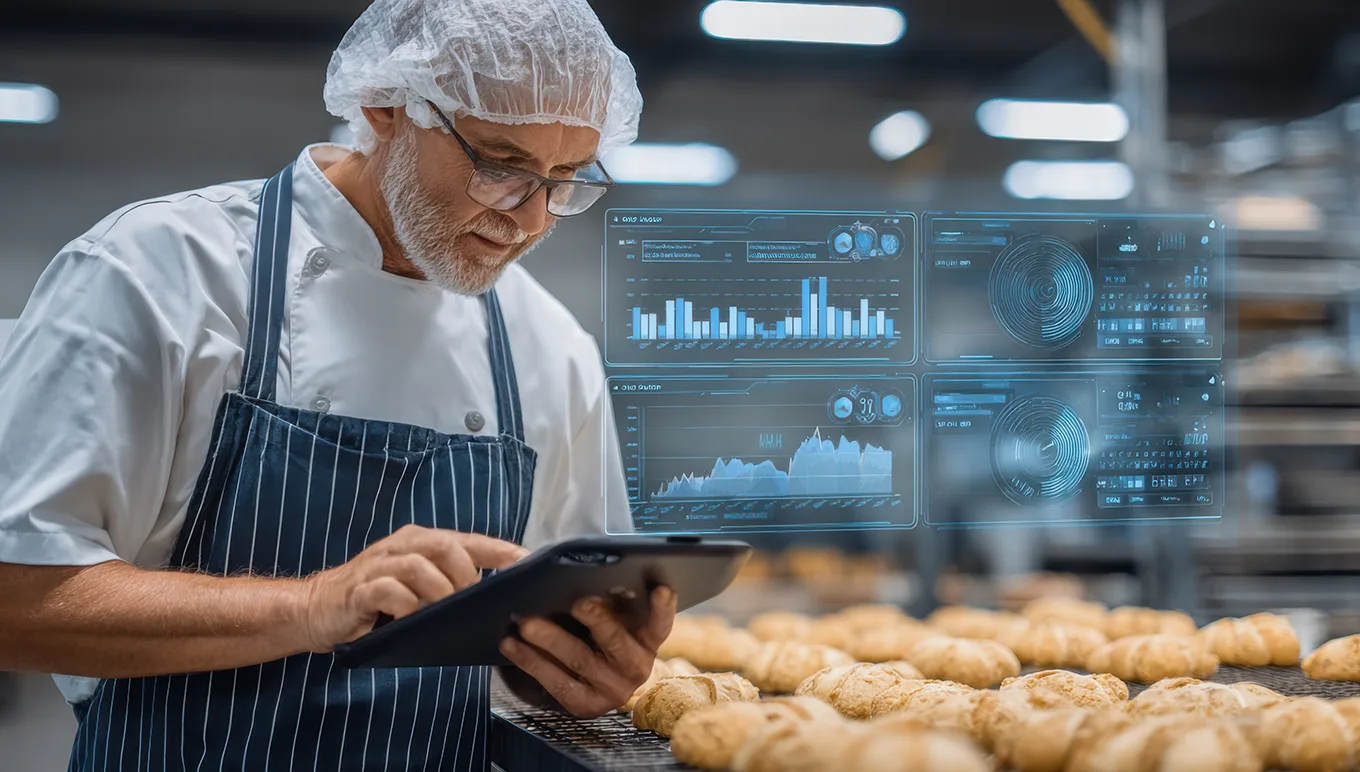
If you heard the word "agent" 30 years ago, you probably pictured J from Men in Black chasing aliens around Manhattan or Jerry Maguire yelling "show me the money!" into a phone. Today, it’s more likely that it calls to mind something else entirely.
That’s because thanks to artificial intelligence (AI), “agent” now means a software tool that uses AI to act autonomously, working through a task and coming back with an answer, recommendation or finished piece of work—all without someone standing over its shoulder the whole time.
It’s important to point out, though, that not every agent is built the same way. A general-purpose or “horizontal” agent can draft an email or summarise a document for any business, regardless of the industry. But vertical AI agents built specifically for food industry manufacturers natively understand concepts a generic assistant never will, like:
The difference between first-in, first-out (FIFO) and first-expiry, first-out (FEFO) picking
Why a changeover requires sanitation of allergens rather than a quick machine reset
How routine variance is different from an error that puts an entire batch on quality hold
That's the difference between generic agents and food business AI agents built for your operational realities.
To give you a full appreciation of the potential value of AI agents for food and beverage businesses, below we share nine examples of those already at work across the industry today, from the first step of purchasing order through production and distribution, to post-production audits.
We’ll demonstrate the use cases for each; identify the team(s) within your organisation that would actually use the agents and benefit; and how their jobs—and your business outcomes—can improve as a result.
1. Vendor Scorecard Agent
If you're a procurement or planning manager, you’re likely familiar with the traditional method of vendor review: scrutinising a spreadsheet, making a handful of gut calls and relying on memory to identify chronic late shippers. This agent replaces that process by generating a live, weighted score for each of the vendors you work with.
By pulling current data straight from your enterprise resource planning (ERP) system, this agent scores every vendor on a 0-100 scale across delivery reliability, cost stability, quality control (QC) pass rate and compliance history. So instead of waiting for the next quarterly review, you get a composite score instantly whenever you need one, and you can see exactly which factor is dragging a vendor down before you renegotiate a contract or look for a backup supplier.
For a team weighing the risks of sole-sourcing against a stack of new supplier bids, that's the difference between a decision made relying on memory alone and one made on accurate and reliable information.
2. Dynamic Planning and Forecasting Agent
The planners, supply chain managers, procurement leads and operations managers at your organisation probably all ask some version of the same question: “What happens if we run short on a key ingredient next month?” To answer that and questions like it, this agent drafts a multi-week production and supply plan, flags shortages before they become a crisis and suggests alternate vendors when a substitution makes sense.
The draft can cover several weeks of production and supply at once, which is useful given that a single ingredient shortage can ripple across a dozen SKUs. Ask it a what-if question, like “What happens if a shipping lane closes?” or “What if a supplier misses a shipment?” and it answers with a stockout-risk assessment in plain terms.
Every recommendation comes marked as a draft, fully traceable to the source data, until a planner signs off. By affording you valuable opportunities to be proactive and protect from shortages, this agent saves you time and money.
3. Changeover and Scheduling Agent
Every plant manager knows how changeovers can eat away the day: an allergen clean here, a clean-in-place (CIP) cycle there, and suddenly a shift that looked on track to hit targets has lost two hours to changeovers and sanitation. Working from the week's orders, the plant's changeover matrix and each product's shelf life and order due date, the changeover and scheduling agent tests different run sequences to find one that groups compatible products together and cuts unnecessary allergen cleans.
It shows its work, including which resequencing saves the most time and confirms nothing slips past a customer's due date in the process. A planner reviews the suggested schedule sequence and uses their judgment before committing to it, the same way they always have, just with fewer surprises.
In an industry where margins are measured in fractions and decimals, an hour saved on sanitation here and there over time can meaningfully add to your bottom line.
4. Production Efficiency and Variance Agent
For your production planning teams—not to mention quality and finance right alongside them—the real risk isn't a single bad batch. It's the slow drift nobody notices until margins have already taken the hit. This agent continuously compares planned material, labour and machine usage against your bills of materials and routings, then flags the gap when actual and planned start to diverge.
It's built to catch systemic issues, like a master data record that's gone stale or a backflushing mismatch that's quietly overstated scrap for weeks, and it comes with a specific, actionable correction attached, not just a red flag. That helps you prevent the kind of drift that can compound across every shift running the same routing.
When it comes to production issues, catching them early is your best means of protecting your business from loss.
5. Pick Generator Agent
Your warehouse staff already knows a pick list built without expiry in mind causes problems downstream. This agent automates and simulates pick-list creation directly inside your ERP, sequencing picks by bin zone, weight, expiry (using FEFO logic) or customer shelf-life requirements, whichever matters most for that order.
Before anything is committed, the team can preview the pick path and see how efficient it actually is, then adjust before a picker ever walks the floor. Enable time savings, greater efficiency and more by facilitating optimised picking.
6. Cold Chain and Delivery Exception Agent
Once a shipment leaves the dock, your transport or logistics manager's work is far from over. Now, they must do all they can to ensure the product reaches the customer in optimal condition. By keeping watch on live temperature and location data from a shipment in transit and checking that against the order's requirements (safe temperature range, delivery window and shelf life still remaining), a cold chain and delivery exception agent can help protect goods in transit to customers.
If a reefer unit starts drifting out of range or a delay puts a load at risk of missing its window, the agent flags the exception before the truck reaches the dock and recommends the fix—whether that’s rerouting to a closer stop, expediting the remaining leg, or flagging the load for a quality hold and inspection on arrival instead of automatic acceptance.
This is a critical capability for businesses dealing in dairy or fresh protein. An early warning can be the difference between a delivery that arrives within spec and one that turns into a customer claim.
7. Sales Push Agent
Your sales, inventory, operations and finance departments all feel it when perishable inventory starts creeping toward its expiration date without warning and there’s no plan to move it. As it scans your ERP for inventory nearing the end of its window, this agent checks real-time market conditions for shortages or oversupply and then builds a ready-to-use spreadsheet with market-aware recommended sale prices.
Instead of jumping to make a hurried, reactive markdown, your team gets a workbook with recommended sale prices that they can act on the same day. That kind of decision used to depend on someone catching and flagging the expiration dates first.
Now, AI’s got your back, always tracking expiration dates and ready to help you move inventory fast when you need to.
8. Demand Sensing and New Product Introduction Agent
A brand-new or reformulated SKU is a blind spot for anyone at your organisation concerned with allocation, from your planners to fulfillment. There's no sales history to lean on, so a monthly cycle forecast is either built on guesses or borrows a generic category average. This food business AI agent instead watches the earliest real signals after launch, including sell-through velocity, distributor reorder timing and regional variation, then compares them against the closest analog product from a past launch.
If the new SKU is tracking well above or below that analog in the first week or two, supply chain and marketing teams find out immediately, with enough time to adjust the next run before locking in production volume.
That's a meaningfully faster read than a standard monthly forecast cycle would ever provide—and for a launch, timing is most of the decision.
9. Regulatory Compliance and Audit Agent
Your quality assurance and compliance people live with a simple truth: An audit or a recall doesn't wait for a convenient moment. This agent continuously validates compliance data—including vendor certifications, QC and sanitation records and shipment documentation—across your entire buy-make-sell cycle and classifies any exception by risk severity as soon as it appears.
When a recall or an audit does happen, it reconstructs end-to-end product traceability on demand. Now you’re ready before the audit starts, not scrambling once it already has.
Bringing Agents to Your Food and Beverage Operation
If these nine agents make one thing clear, it's that AI agents for the food industry can deliver both immediate and lasting results when they're built around the realities of today’s plant floor, not a generic template. That's the difference between generic automations and food and beverage AI agents that understand FEFO, changeovers, quality holds and the many other complex considerations.
It's the same idea behind Aptean AppCentral, our AI-powered platform that connects your core business systems like food and beverage ERP, routing software and transport management system (TMS) with embedded AI tools that function within the workflows your teams use every day. No clunky bolt-ons or expensive customisations necessary.
And for businesses ready to dive in with agents, that’s where Aptean Intelligence as a Service (AIaaS) comes in: our fully managed AI program in which Aptean specialists design, build and deploy custom agents like those described above. You get ready-to-use functionality built around your processes, data and desired business outcomes, without having to hire an AI team or take on a new integration project.
Our specialists can typically move from the initial meeting to a defined use case and into production in weeks, not quarters. Human review and governance are built in from day one rather than added on afterward.
Customers like Toufayan Bakeries are already enjoying the benefits: The business’s traceability agent has cut a task that used to take an eight-person team four hours down to a one-person job that takes under an hour.
That's agentic AI for food businesses in practice. Not a chatbot or another dashboard, but a virtual team member who flags what needs attention, drafts a recommendation and leaves the final call where it belongs—with the people who actually know your plant.
So whether you're scoring vendors, sequencing changeovers, getting ready for the next audit or trying to optimise another food industry-specific process, a purpose-built agent built for your industry will always understand more than one built for everyone else.
If you want to imagine them as stoic individuals in sunglasses and dark suits saving the world or high-profile lawyers that help get deals done, that's fine too. These agents are also experts who can be relied on for a job well done, but now they’re digital.
Ready to learn more about AI agents for food and beverage businesses and how they can help your company overcome the problems holding you back? Contact us today or schedule a personalised demo.

With more than 30 years of food and beverage industry experience, Jack is a seasoned expert in helping manufacturers, processors and distributors solve complex operational challenges with technology—he even wrote the book on it. With deep expertise in enterprise resource planning (ERP), supply chain optimization and regulatory compliance, Jack is passionate about helping companies drive efficiency, traceability and growth through purpose-built software.
At Aptean, Jack collaborates closely with product, sales and customer teams to align technology innovation with real-world business needs—especially in highly regulated and fast-moving industries. A frequent speaker at industry events and contributor to trade publications, Jack is known for his clear-eyed insights, practical advice and deep understanding of what it takes to succeed in the food and beverage industry.
From family-owned bakeries to global beverage brands, Jack brings valuable perspective to businesses of all sizes and specialties. His insights draw from decades of hands-on experience across sectors like dairy, produce and packaged goods.
By Jack Payne| Vice President, Product Management & Solutions Consulting
Related Content

Agentic AI vs. Generative AI: What Different Types of AI Mean for Your Business
Learn the difference between agentic, generative and predictive AI—and how to use them together to improve efficiency, forecasting and automation.
The Food industry Trends To Watch In 2026
What food and beverage trends will matter most in 2026? See how consumer demand, AI and operational shifts are changing what it takes to compete.