
AI 101: What Every Operations Leader Actually Needs to Know
Only Have a Minute? Here Are the Key Takeaways:
AI isn’t magic—it’s maths. It’s software that learns from data and improves over time, unlike traditional software that follows fixed rules you write.
Three types matter for your operations: machine learning for predictions, generative AI for content, and AI agents that monitor, decide and take action.
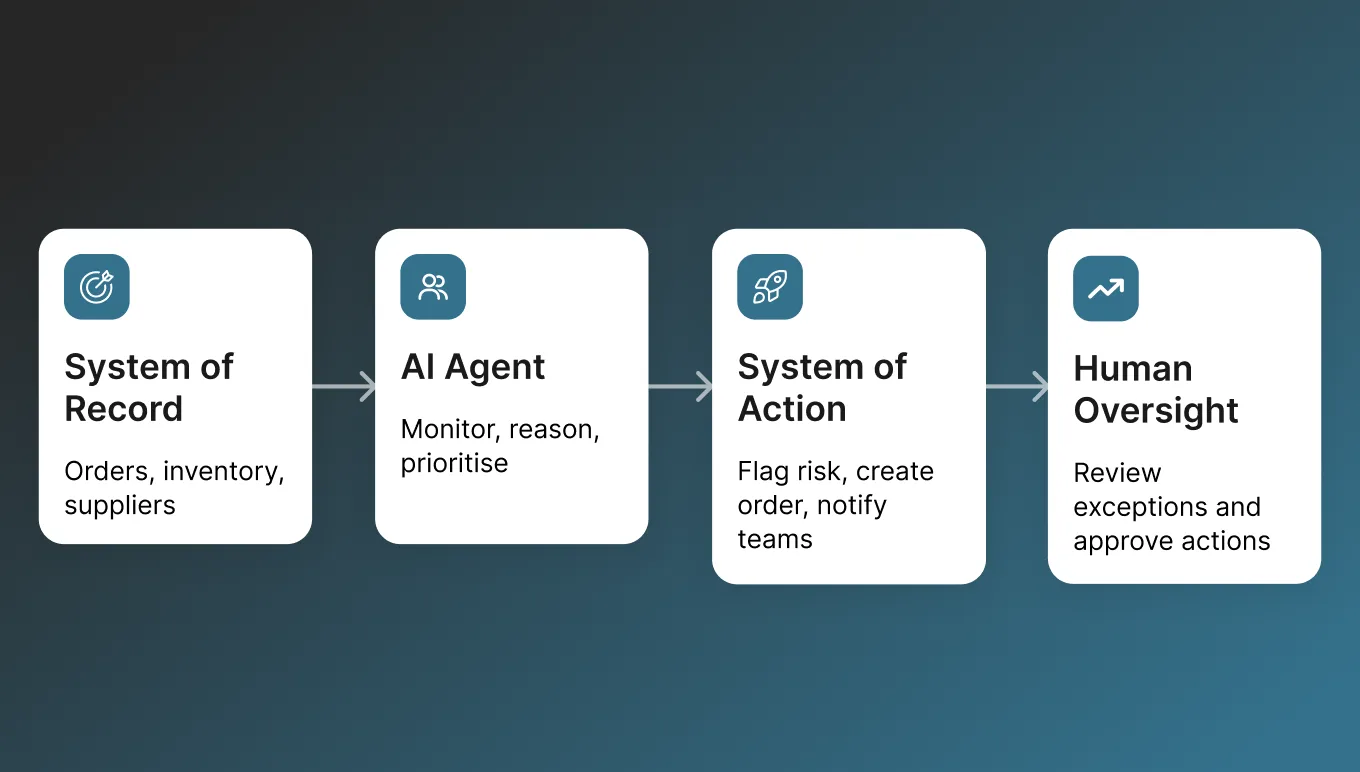
Your ERP is your system of record. AI agents are your system of action. They act on the data already in your systems to drive outcomes without waiting to be asked.
Generic AI knows language. Industry-specific AI knows how your business operates. The difference shows in how well it understands your core business systems’ data, workflows and compliance requirements.
You don’t need to hire a data science team or rebuild your tech stack. The right managed service can take you from discovery to a live agent in weeks.
Thursday, 16 July 2026
6 min

By Aptean Staff Writer
Share this report
Featured in this post
As a manufacturing leader, you don’t need to understand how artificial intelligence (AI) works in great detail. But you need to understand what it changes.
That’s not a dismissal of the technology—it’s just the most practical framing for operations leaders evaluating AI right now. The vendors and headlines want you focused on architecture, models and infrastructure. What you should really be asking yourself is, which processes on your team are slow, error-prone or still living in a spreadsheet? Because those are exactly the kinds of processes where AI can be transformative.
The challenge is that getting there requires cutting through a lot of noise. Jargon piles up fast—machine learning, large language models (LLMs), agentic AI, generative AI—and most of it arrives without context that’s useful to someone running a production facility or logistics network. And this uncertainty delays decisions that genuinely matter.
This post is the plain-English version of that conversation. It covers what AI actually is, why it behaves differently from the software you already use, where it belongs in an operations environment and what’s holding most teams back from getting started.
The Four Terms Worth Knowing
Before we go any further, let’s briefly cover four terms for the sake of clarity:
AI: Software that learns from data to make decisions and recommendations. Learns from patterns and examples, getting more accurate over time.
Machine learning: The branch of AI that finds patterns in historical data to make predictions. Enables demand forecasting, anomaly detection, cash flow predictions and more—based on your actual operational data, not assumptions.
Generative AI: Creates content, including text, summaries, reports and recommendations. Powers ChatGPT and Microsoft Copilot. Useful for making complex information accessible; surfaces answers from your data.
AI agents (also called agentic AI): Specialised digital workers with defined roles: monitoring conditions, making decisions within guardrails and taking action (like updating a sales order, generating a purchase order or flagging an exception for human review).
Your ERP Stores Data—AI Agents Act on It
Here’s a useful way to think about how AI fits alongside the systems you already run.
Your enterprise resource planning (ERP) system (or, in the absence of ERP, your core business solution) is your system of record. It captures everything that happened, including orders, inventory levels, supplier lead times, production runs and financial transactions. It’s authoritative, structured and essential. But it only records what happened; it doesn’t act on it.
AI agents are your system of action. They use the data in your system of record to conduct a task—proactively, consistently and at a speed no team can match manually.
The contrast with traditional software is worth making concrete. Traditional software is deterministic: If an order value exceeds a threshold, apply a discount. But that logic only works until it doesn’t. What if the customer has 10 overdue invoices? Or you’re out of stock of what was ordered? Traditional software can’t weigh competing priorities. You write the rule once, and the system follows it regardless of context.
AI works differently. You give it data and outcomes, and it learns the rules itself. It can flag a discount request against an at-risk customer account. It can surface the fact that promoting a product you’re already short on could create a fulfillment problem downstream. It handles complexity naturally—and not because someone coded every edge case, but because it learned them from your history.
Where AI Actually Belongs in Your Operations
The clearest signals that a process is a good fit for an AI agent: It’s manual, time-consuming or spreadsheet-driven.
Even at the most successful of businesses, the copy/paste economy is at work. Look for the person who downloads a report, reformats it in Excel and emails it to four people every Monday morning. Or the purchasing team that manually reviews material requirements planning (MRP) outputs, drafts purchase orders and chases suppliers on delivery confirmations.
These aren’t edge cases. They’re the texture of most operations, and AI agents are built for exactly this work.
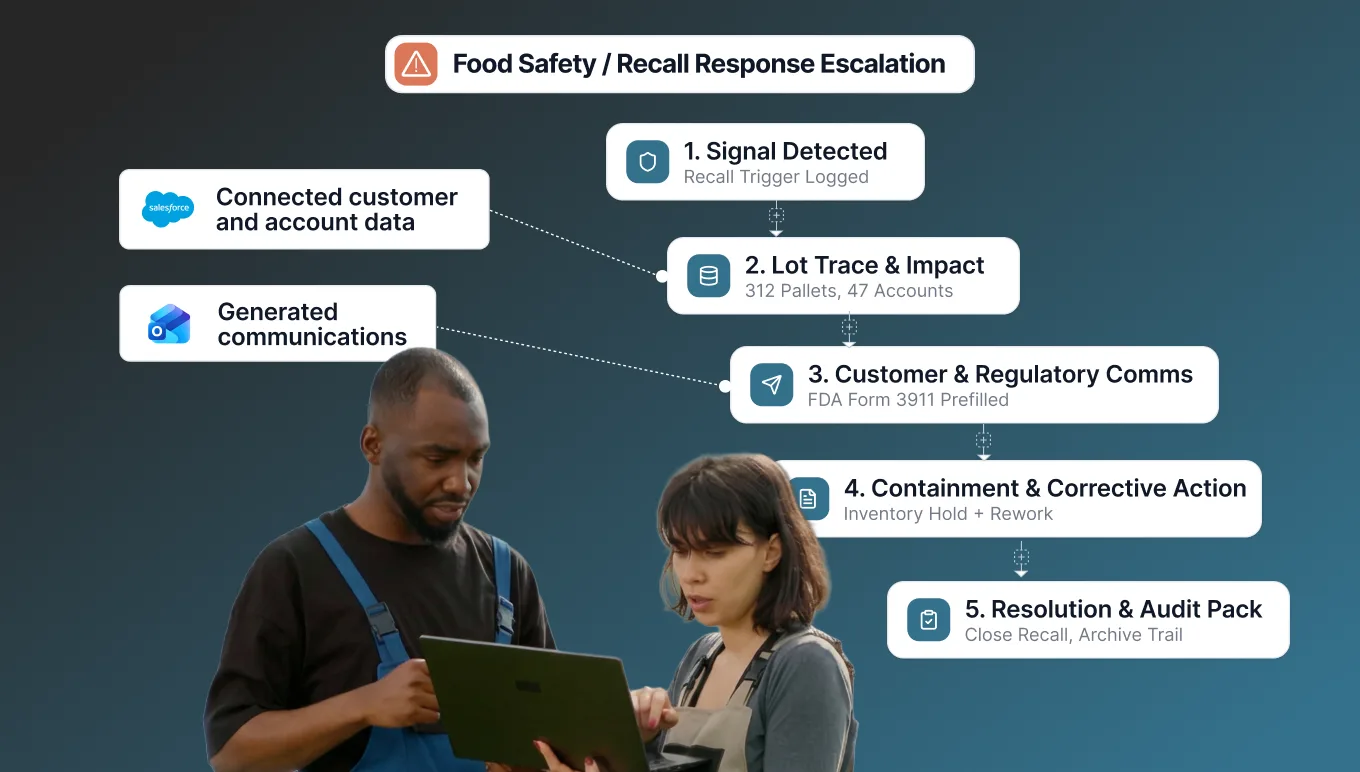
A traceability agent, for example, can take a lot number and return a complete forward and backward trace in minutes—every affected customer and contact number in a packaged summary file—instead of the hours-long manual process that typically requires multiple people.
A purchasing agent can run MRP signals, apply business constraints, generate purchase orders and send them to vendors automatically, freeing your purchasing team to focus on exceptions, negotiations and supplier relationships rather than administrative follow-through.
The pattern holds across functions. The time your teams spend finding, formatting and moving information is time an AI agent can give back.
What’s Holding Most Teams Back—and What Doesn’t Have To
In conversations with operations leaders, four objections come up consistently. We’ll address them directly.
“Will AI replace my team?” No. AI agents handle the repetitive, time-consuming work so your people can focus on judgment, relationships and exceptions—the stuff that actually requires human expertise. The goal is to make your team’s time more valuable, not to replace it.
“Our data isn’t clean enough.” Imperfect data is a use case, not a blocker. One of the most common things AI agents do is surface and fix data quality issues that have always existed but were invisible in a manual process. You don’t need a clean-room data environment before you can start.
“We don’t have time for a big AI project.” Who said anything about a big project? The right approach is to identify one specific process, define what the agent will (and won’t) do, and go live. Properly structured, that takes weeks, not months. The 12-to-18-month timelines that come up in the market apply to organisations building their own AI infrastructure from the ground up. That’s not a requirement if you’re working with a partner who already understands your data and your industry.
“Why doesn’t our core business system just do this?” Because ERP and other core business systems are designed to manage and store data, not to proactively act on it. It’s a gap that agents are specifically designed to fill. AI doesn’t replace your operational solutions; it gives it a workforce to act on everything it already knows.
As long as you’ve got modern business solutions, you already have what you need: operational data, defined processes, and a clear sense of where your team’s time goes. The rest is finding the right partner to build on it.
That’s where Aptean comes in. We’ve spent decades building and supporting the manufacturing and supply chain systems that food manufacturers, apparel companies and logistics businesses rely on every day. We know your workflows, your data structures and the operational pressures your industry actually faces—not in the abstract, but in practice.
Our Aptean Intelligence as a Service (AIaaS) offering is built on that foundation. It’s a fully managed service in which our team designs, builds, deploys and continuously optimises purpose-built AI agents for your operations. You don’t need to hire data scientists or stand up new infrastructure; we handle it.
Because we build your agents to work with your existing data and workflows, there’s no heavy integration work upfront and no new system to learn. And because we manage and optimise your agents over time, they improve as your business evolves, so you’re not left maintaining something that goes stale six months after go-live.
From an initial discovery conversation to a live agent typically takes weeks, not months. The only question left to answer is which problem you want to solve first.
If you’re ready to explore what AIaaS can do for your business, contact us today. You can also schedule a personalised demo at your convenience.
To learn more about AI and how Aptean’s next-generation solutions are setting a new standard in enterprise software, explore the Aptean AI Academy, featuring live and on-demand sessions with our experts.

By Aptean Staff Writer
Related Content
AI Agents at Work: What They're Actually Doing in Your Operations
See how AI agents handle the coordination work behind purchase orders, audits, and disruptions — so your team can focus on judgment. Learn more now.

Biggest AI Adoption Challenges and How To Overcome Them
Explore the biggest challenges organizations face when adopting artificial intelligence and learn practical ways businesses can overcome barriers to successful AI implementation.

Democratising AI: What It Means and How No-Code AI Tools Empower Your Employees
Discover how no-code AI puts powerful capabilities into the hands of nontechnical staff, helping every employee work faster, smarter and more confidently.