
The Vertical AI Data Bank
Citable Statistics on Enterprise AI, Vertical AI, and the Gap Between Promise and Proof
About This Research
The Aptean 2026 Artificial Intelligence Research is a multi-region study of how organizations are putting artificial intelligence (AI) to work, where it’s paying off, where it isn’t, and why. Aptean commissioned independent research firm Vanson Bourne to survey 1,535 decision-makers at businesses with $10 million or more in annual revenue across six markets (the United States, Canada, the United Kingdom, the Netherlands, France, and Germany) and five industries: food and beverage; apparel and soft goods; transportation and distribution; discrete and process manufacturing; and equipment dealers, plus a cross-sector supply chain cut. Participants were business and IT leaders, from the C-suite to management, with direct involvement in their organization’s AI strategy and influence on decisions relating to enterprise resource planning (ERP) or supply chain management (SCM) systems.
The 25-question survey tested a straightforward hypothesis: AI built for a specific industry outperforms general-purpose tools. This research was supported by 10 in-depth interviews and significance tested at the 5% level. This page collects the headline findings in a single, scannable place.
When citing any figure from this page, please use the source statement below and credit both Aptean and the independent research firm Vanson Bourne.
Source: Aptean 2026 Artificial Intelligence Research, conducted by Aptean and Vanson Bourne in 2026. The study surveyed 1,535 business and IT decision-makers at organizations with $10 million or more in annual revenue across six markets. © Aptean 2026.
A few notes for accurate use:
Please credit both Aptean and Vanson Bourne on first reference to any figure.
Statistics included in charts and cited in text have been rounded; multi-select questions may not total 100%.
When citing a comparison (for example, vertical AI versus general-purpose AI, or North America versus Europe (UK/FR/DE/NL)), keep both figures together so the contrast isn’t lost.
For the full report, methodology, or interview requests, contact the Aptean communications team at [email protected].
Part 1: Cross-Vertical, Cross-Regional AI Adoption Statistics
80% of organizations still don’t consider AI essential to their workflows
87% believe their organization risks falling behind, or even becoming obsolete, without successful AI implementation.
92% say outside expertise or support would help them get more from AI.
82.5% agree that AI’s value is clear but hasn’t been fully realized yet—expectations are still outpacing outcomes
40% admit to using AI tools for work without formal approval from their organization—a measure of “shadow AI.”
88% already allow AI to act autonomously in at least one area, with no human in the loop.
96% vs. 36% recognize that a formal AI governance framework is required, yet 36% haven’t built one—and 75% call that absence a major barrier to AI success.
Improvement of 8 of 8 operational metrics were led by organizations using both industry-specific and general purpose AI over those using only general-purpose tools.
88% say purpose-built, industry-specific AI is critical or very important to them; 99% say it matters at least somewhat.
77% say general-purpose AI tools are insufficient for the needs of large, complex operations.
47% cite easier integration with existing systems (such as ERP and supply chain platforms) as one of the main reasons they value purpose-built AI, ahead of more accurate outputs (42%) and stronger ROI (38%).
98% of organizations are already using or implementing AI—non-adoption is now a statistical rarity.
86% say operational efficiency has improved over the past year.
46% say AI is integrated into or essential to their core workflows; the majority (52%) are still progressing from pilots and departmental use toward full integration.
83% vs. 17% adopted AI driven by opportunity (the chance to move faster and compete harder) rather than fear of falling behind.
81% say data quality or access is the single greatest barrier to successful AI implementation.
82% say integrating AI with their core systems is a bigger challenge than the AI itself.
86% agree that adopting AI without modernizing the systems around it is unlikely to deliver full value.
43% rank operational efficiency gains as a top-three success metric for AI, followed by cost savings (36%) and decision quality and speed (34%).
49% allow AI to make autonomous decisions in forecasting and planning, making it the most common area for autonomous AI use, ahead of customer-facing decisions (48%) and strategic decisions (42%).
77.7% vs. 70.3% of industry-specific AI users reported a rising net promoter score (NPS), versus general-purpose users; customer retention improved for 84.1% versus 79.7%—both gaps statistically significant.
Part 2: AI Usage Statistics by Geography
57% vs. 38% of North American food and beverage organizations use verticalized AI, versus their Europe (UK/FR/DE/NL) peers.
48% vs. 31% of North American food and beverage organizations report faster product delivery from AI, versus Europe (UK/FR/DE/NL); revenue growth improved for 45% versus 33%.
29% vs. 18% of North American apparel organizations say AI is essential to core workflows and decision making, versus Europe (UK/FR/DE/NL).
50% vs. 41% of North American apparel organizations plan to move at least some of their on-premises enterprise solutions to the cloud in the next 12 months, versus Europe (UK/FR/DE/NL).
74% vs. 61% of North American transportation and distribution organizations cite regulatory and compliance reassurance as a required safeguard before allowing AI to operate autonomously in higher-risk decisions, versus Europe (UK/FR/DE/NL).
73% vs. 59% of North American transportation and distribution organizations require ongoing performance monitoring before extending AI autonomy, versus Europe (UK/FR/DE/NL); 65% versus 53% require clear escalation and incident management procedures.
40% vs. 30% of North American manufacturers report that vertical-specific AI tools exceeded their expectations, versus the manufacturing vertical average.
49% vs. 34% of Europe (UK/FR/DE/NL) equipment dealers report AI improved compliance and risk management over the past 12 months, versus North America.
43% vs. 31% of Europe (UK/FR/DE/NL) equipment dealers allow AI to make workforce decisions autonomously, versus North America.
59% vs. 53% of supply chain leaders in Europe (UK/FR/DE/NL) cite a business case with quantified ROI as most influential for securing AI budget, versus North America; 53% versus 42% cite strategic goal alignment.
67% of French apparel organizations use AI tools without formal approval—well above the 44% cross-vertical average.
56% of French equipment dealers use AI tools without formal approval (versus a 45% cross-vertical average), and 55% of those who believe industry specific AI is critical or very important value purpose-built AI for its fit with regulatory and compliance requirements (versus 42% cross-vertical average).
AI in Business Statistics by Vertical
Findings broken out by the five surveyed industries, plus a cross-sector supply chain cut.
Food and Beverage
Gaining momentum and delivering measurable results, but maturity hasn’t yet caught up with ambition.
84% of food and beverage organizations were motivated to adopt AI by opportunity rather than risk.
46% / 45% use verticalized AI / custom-built AI.
23% say AI is essential to core workflows—second only to apparel.
29% vs. 19% of food and beverage vertical-AI users improved forecast accuracy by 10% or more, versus general-purpose AI users.
44% use AI tools without formal approval, above the cross-vertical average.
Apparel and Soft Goods
Leading the shift to vertical AI and translating it into business advantage and workforce impact.
53% / 55% use verticalized AI / custom-built AI—the highest adoption of any vertical.
24% say AI is essential to core workflows, the highest of any vertical.
46% plan to move at least some on-premises systems to the cloud in the next 12 months (versus a 38% average).
75% / 68% require strong data governance / clear escalation or incident management procedures before granting higher-risk AI autonomy—the most rigorous safeguards of any vertical.
41% report stronger competitive positioning and/or improved workforce morale from AI in the last 12 months, the highest of any vertical.
Transportation and Distribution
Realizing practical gains today, while recognizing room for greater value and stronger safeguards.
77% agree AI’s value is clear but hasn’t been realized yet (versus the 82% average).
47% / 37% use verticalized AI / custom-built AI.
47% / 44% report AI delivered faster, more accurate decisions / reduced operating costs.
13% / 12% / 11% improved revenue growth / on-time delivery or order fulfillment rate / customer retention rate by 10% or more over the past year.
Discrete and Process Manufacturing
A strong efficiency mindset, with other AI gains and the value of vertical AI less recognized.
64% say operational efficiency and process optimization is where they expect AI to have the greatest impact on their industry over the next 12-18 months(versus a 53% average).
45% / 39% use verticalized AI / custom-built AI—the lowest vertical adoption.
21% strongly agree general-purpose AI is insufficient for large complex operations—below the 32% cross-sector average, the least convinced sector of the need for vertical AI.
46% / 40% allow AI to make autonomous forecasting and planning / customer-facing decisions —below cross-vertical averages, reflecting more caution.
Equipment Dealers
See the case for vertical AI clearly, but practical and workforce concerns slow the path to adoption.
86% agree general-purpose AI is insufficient for large complex operations—the highest of any vertical (versus 77% average).
49% have actually implemented vertical-specific AI.
23% were motivated to adopt AI by perceived risk rather than opportunity (versus 17% cross-vertical)—the most cautious vertical.
27% vs. 18% of equipment-dealer vertical-AI users improved production yield/ waste reduction in the past 12 months, versus general-purpose users; customer retention improved for 23% versus 16%.
22% / 20% / 18% of equipment-dealers report improved operational efficiency / revenue growth / customer retention by 10% or more.
Supply Chain (Cross-Sector Cut)
Executives struggle to source fit-for-purpose AI, constraining the value they realize from it.
63% currently use general-purpose AI (versus a 72% average)—less reliant on generic tools.
48% / 46% / 45% report AI improved compliance and risk management / decision making / product delivery the most over the past year.
15% / 16% / 14% of supply chain leaders report improved operational efficiency / employee productivity / forecast accuracy by 10% or more.
Media Charts & Graphics
Visual data from our latest research, available for journalists, analysts, and content creators. Please be sure to use images uncropped with appropriate attributions.
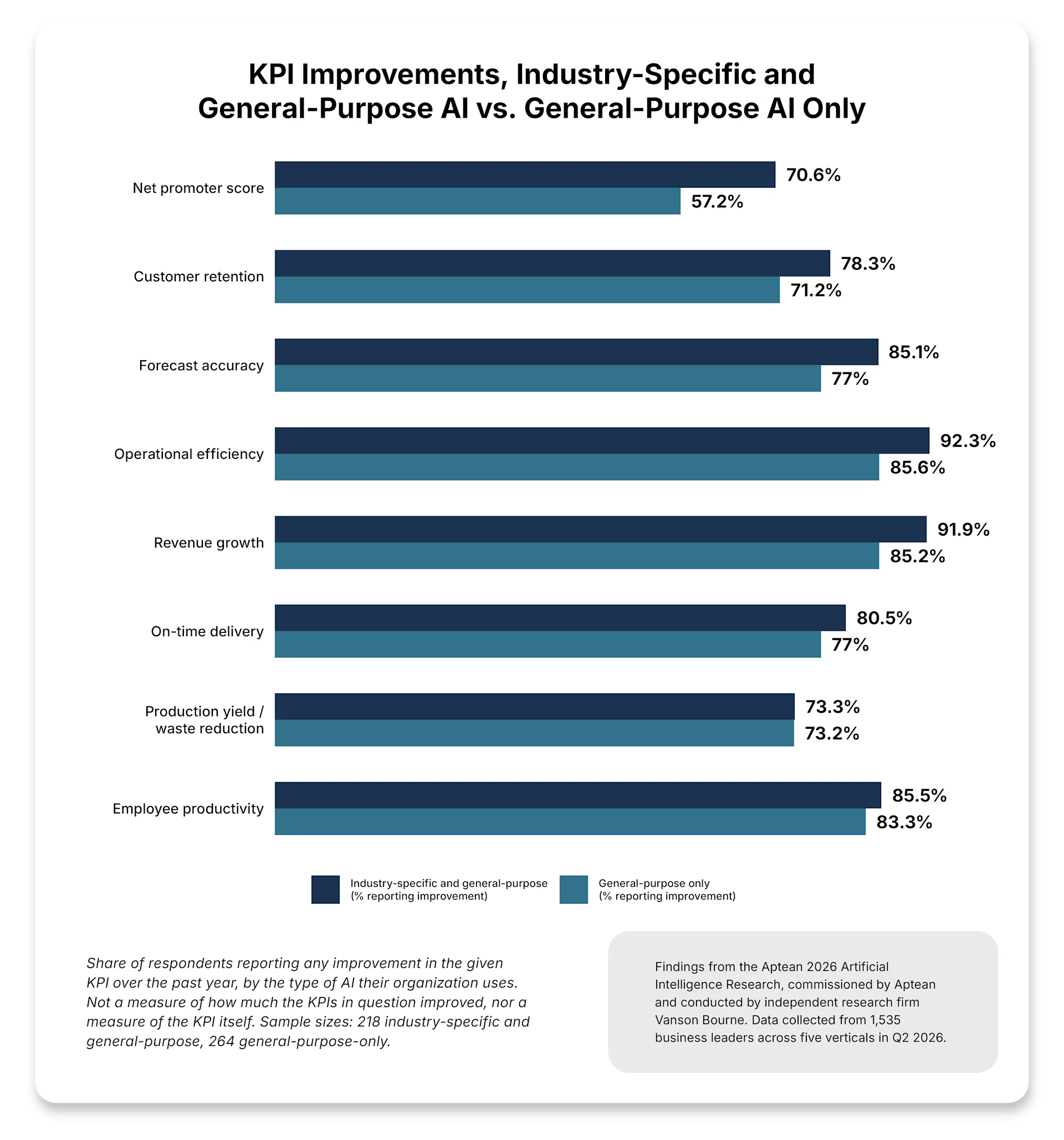
KPI Improvements, Industry-Specific and General-Purpose AI vs. General-Purpose AI Only
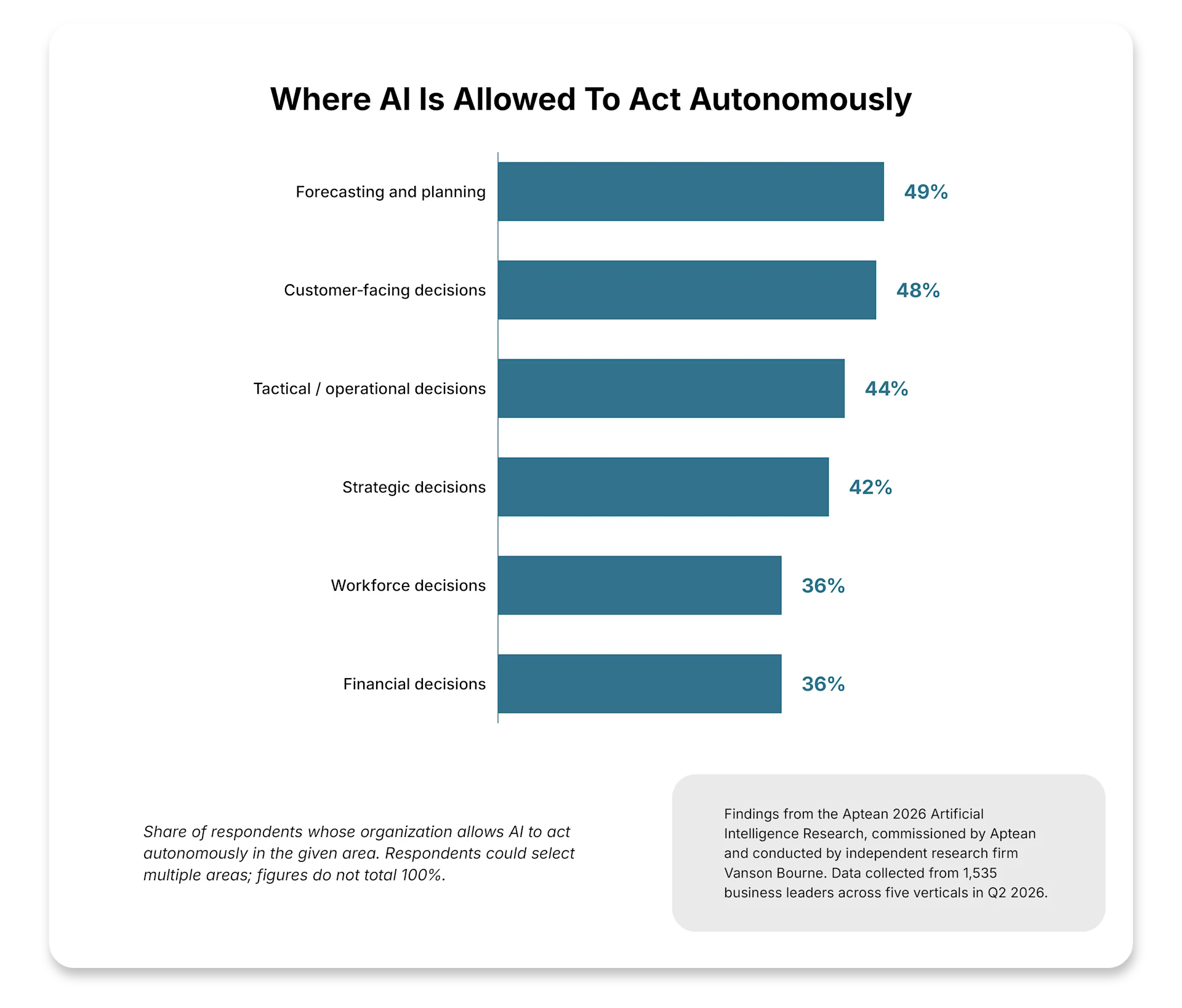
Where AI is Allowed to Act Autonomously
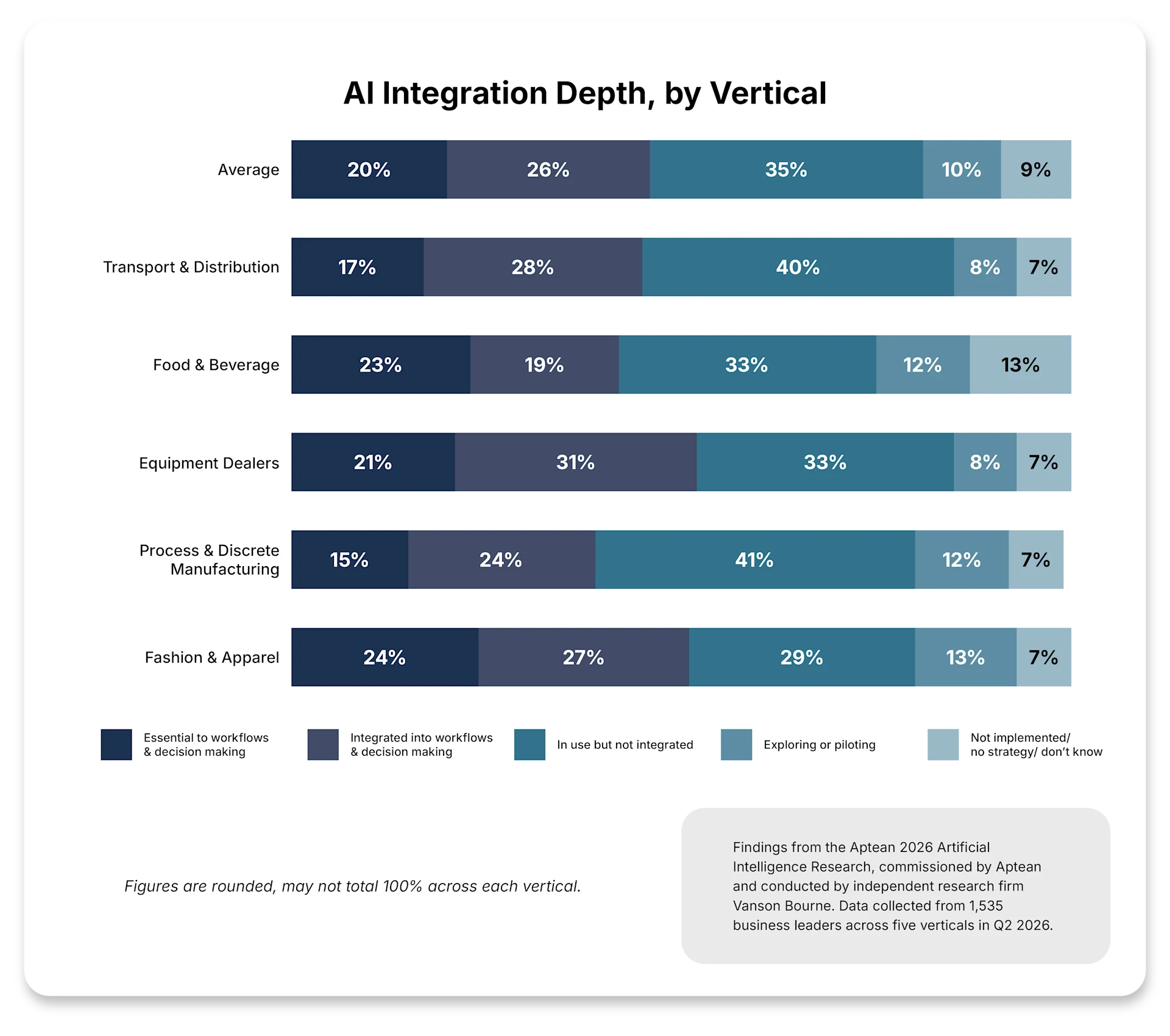
AI Integration Depth, by Vertical
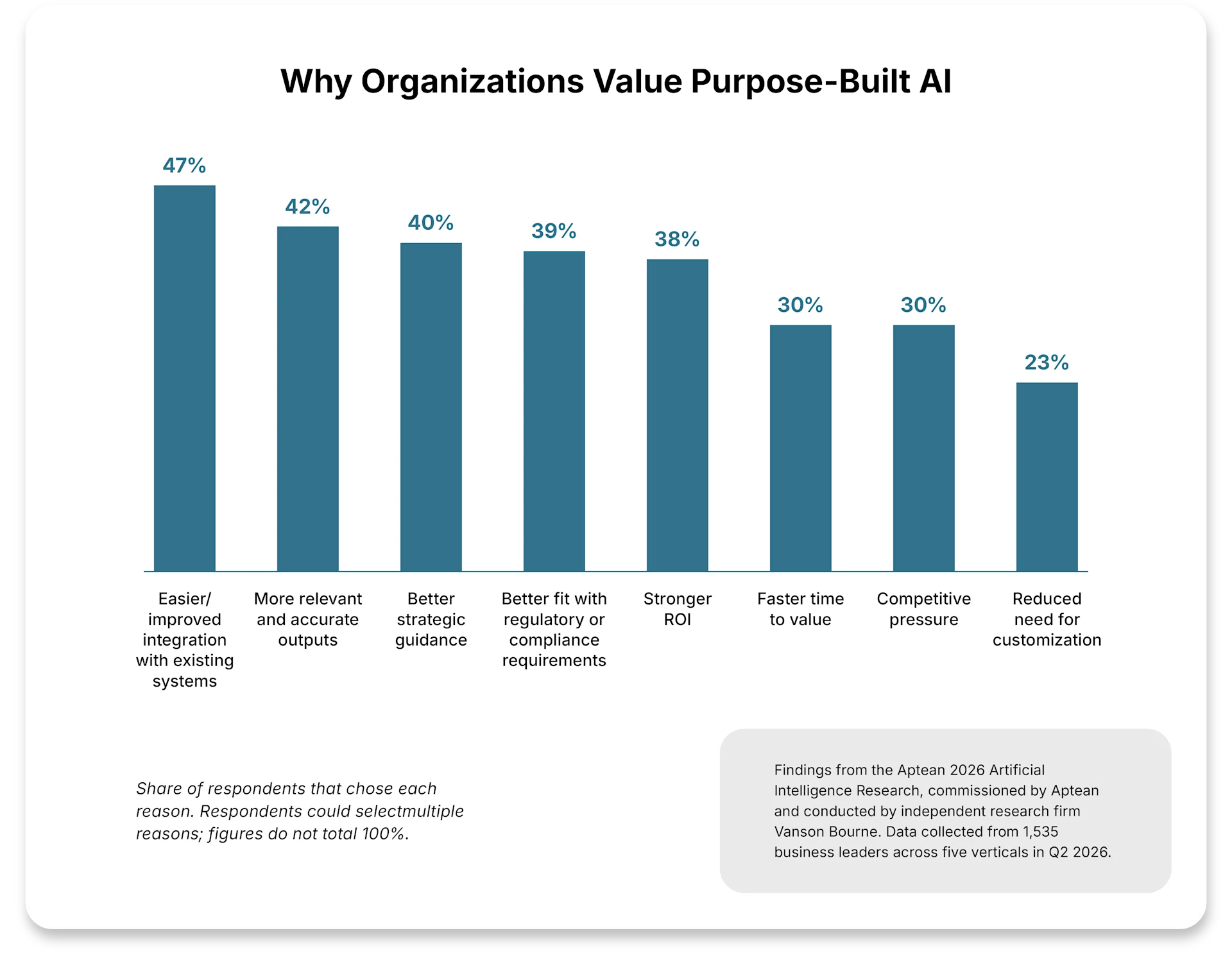
Why Organizations Value Purpose-Built AI
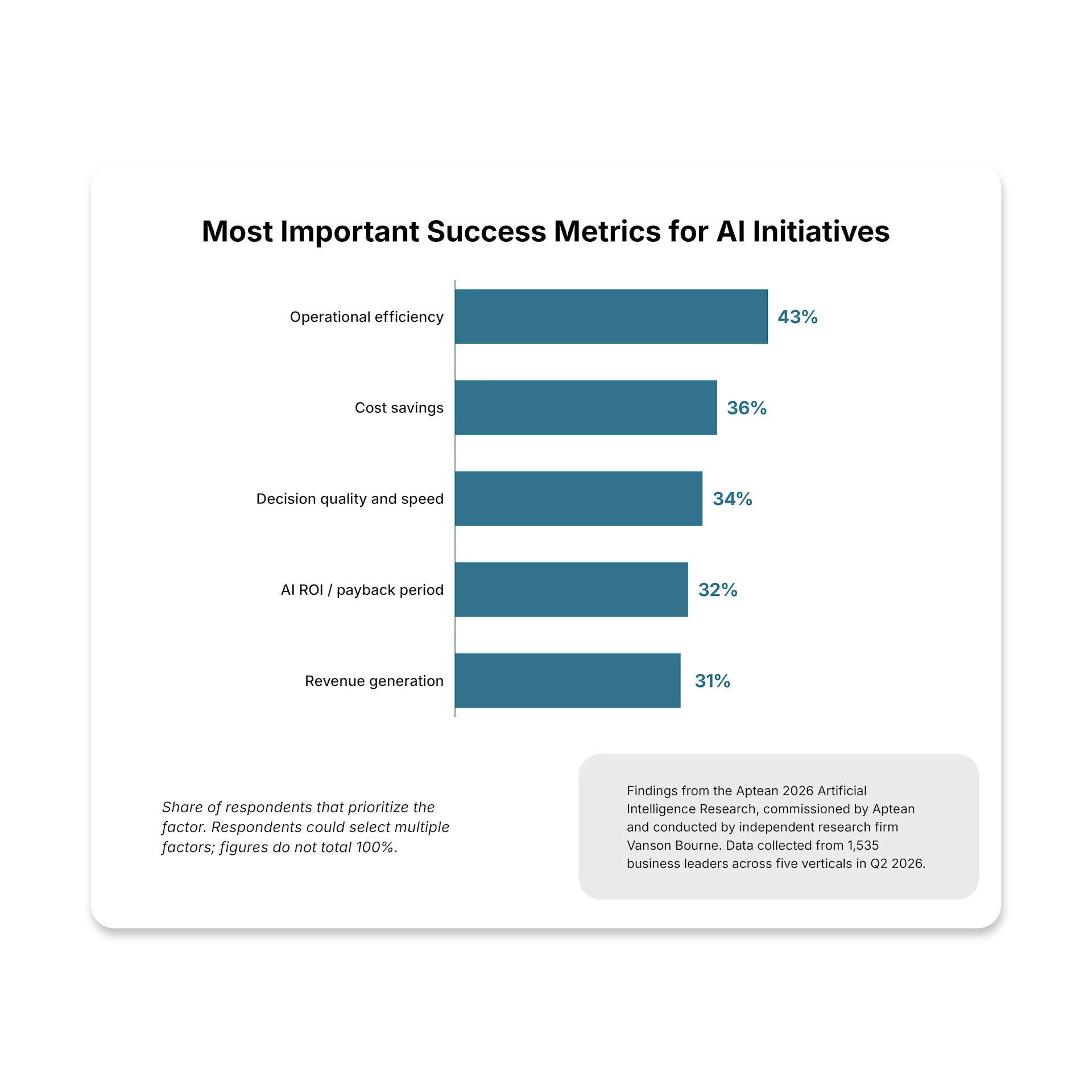
Most Important Success Metrics for AI Initiatives
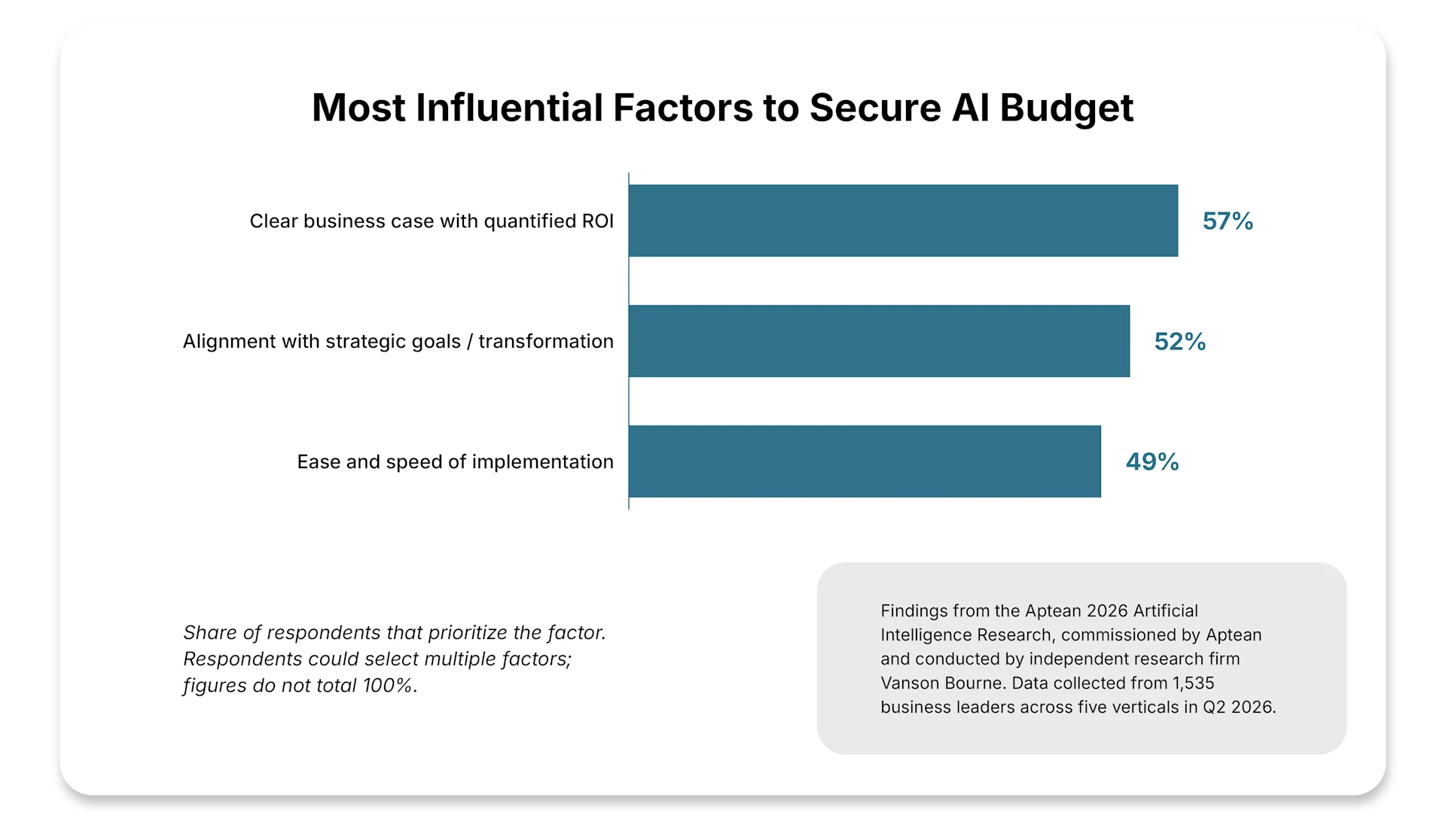
Most Influential Factors to Secure AI Budget
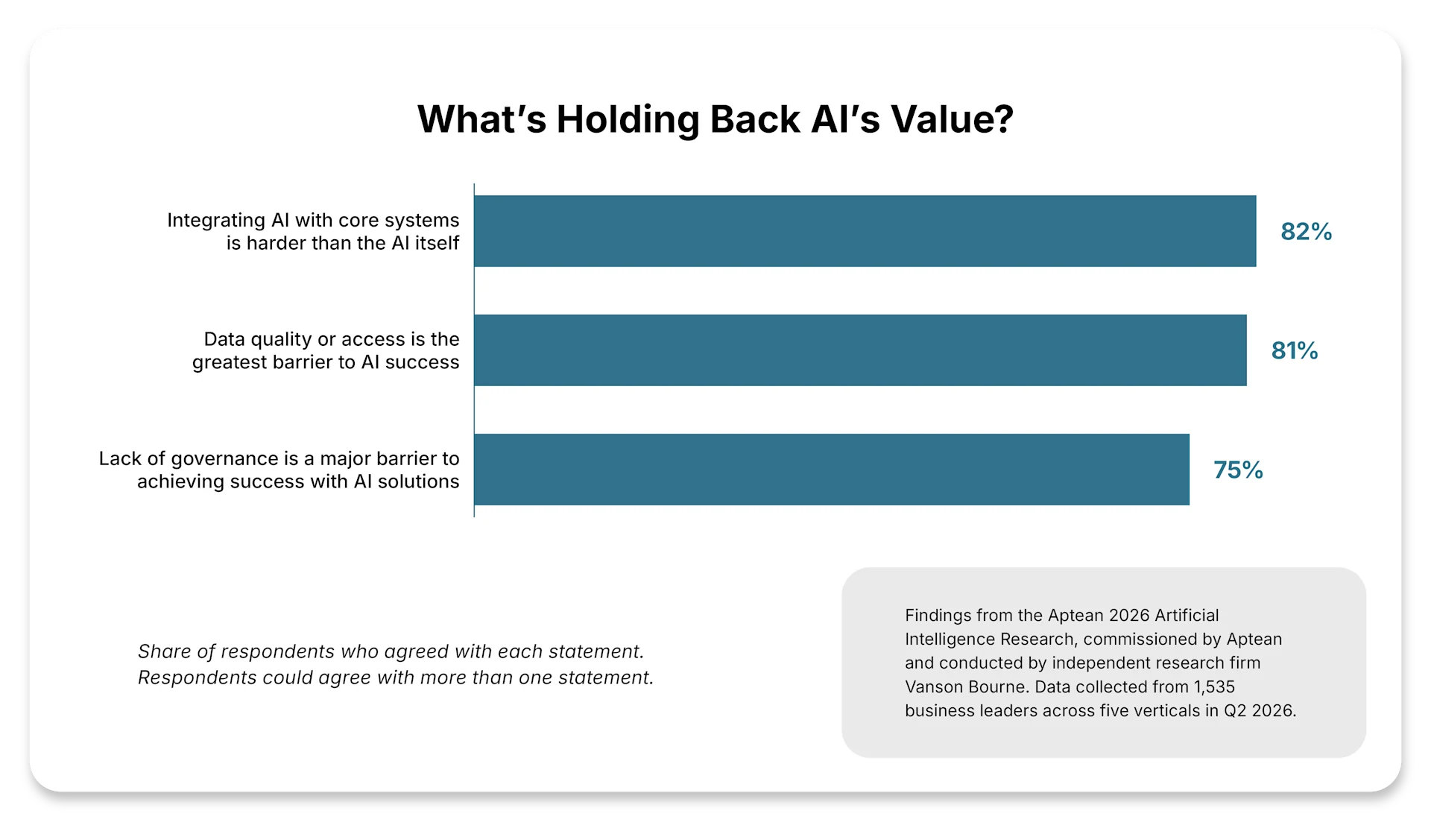
What’s Holding Back AI’s Value
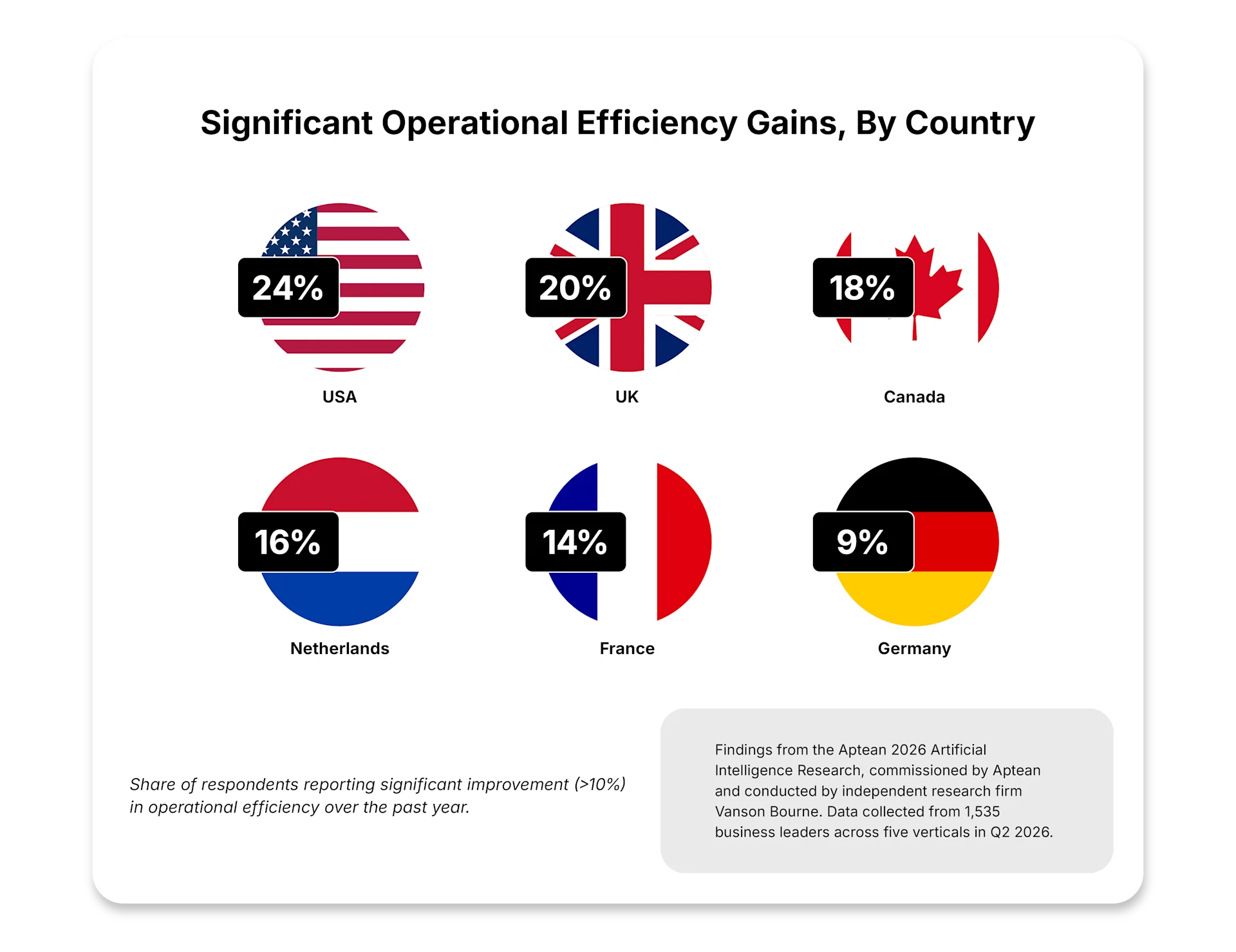
Significant Operational Efficiency Gains, By Country
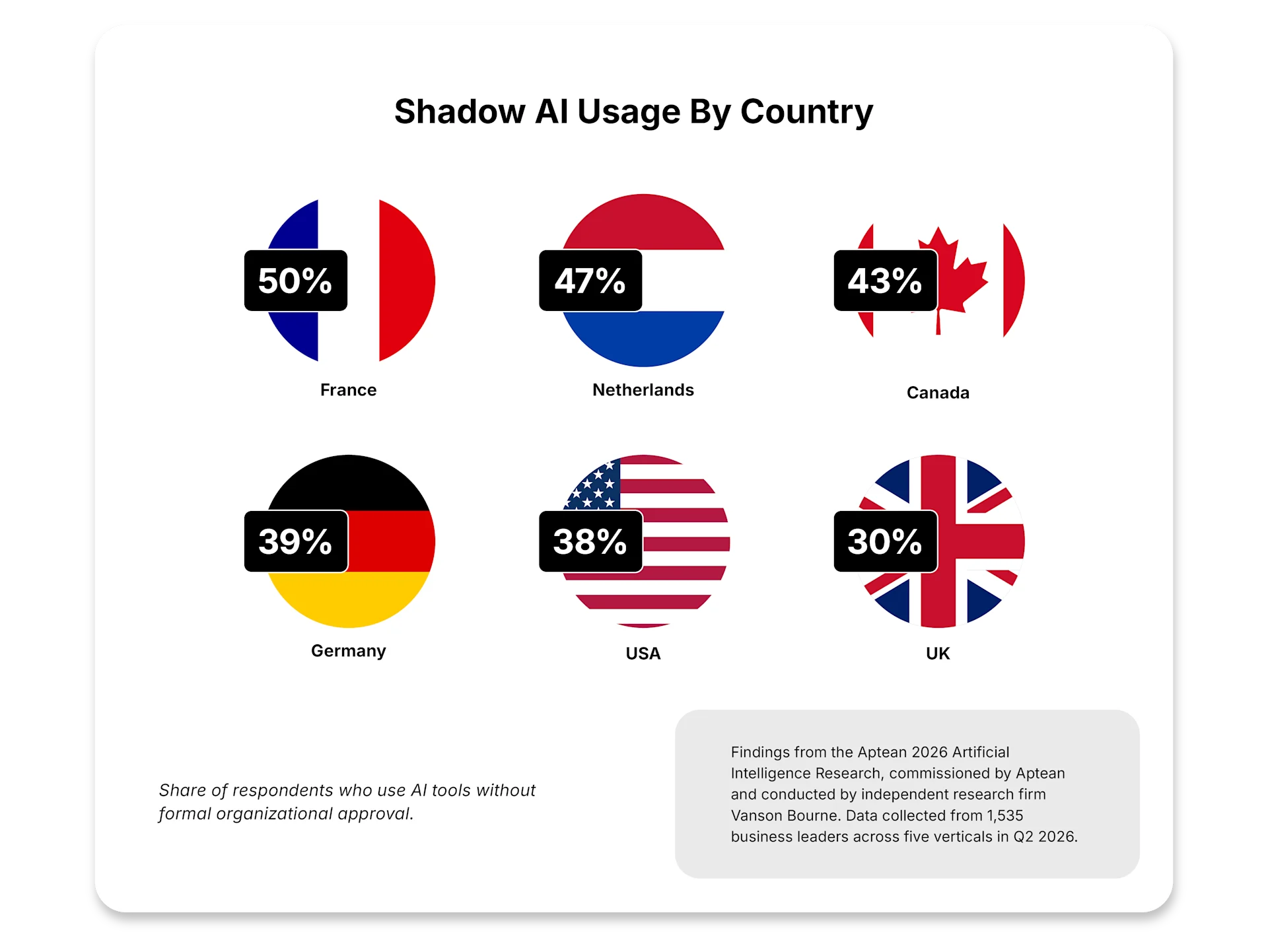
Shadow AI Usage by Country
The Complete Aptean 2026 Artificial Intelligence Research Findings
Alongside the survey data, this report draws on firsthand interviews with business leaders for a close look at where AI is working, where it's falling short and what it takes to see a real return on investment (ROI).
About Aptean
Aptean builds purpose-built software that helps manufacturers and distributors run and grow their businesses with confidence. Our industry specific solutions are designed around the daily realities of the verticals we serve, so organizations can move into the AI era without disruption. Aptean is headquartered in Alpharetta, Georgia and has offices in North America, Europe and Asia-Pacific. Read the full Aptean 2026 Artificial Intelligence Research report for the analysis behind these numbers, or explore Appcentral, Aptean's AI-powered platform.
About Vanson Bourne
Vanson Bourne is an independent specialist in market research for the technology sector. Their reputation for robust and credible research-based analysis is founded upon rigorous research principles and our ability to seek the opinions of senior decision makers across technical and business functions, in all business sectors and all major markets. For more information, visit www.vansonbourne.com.