
Stitching Together the Full Scope of Apparel Software
Only Have a Minute? Here's What You Need To Know
Apparel software is technology built specifically for the steps in an apparel supply chain, rather than general business software adapted to fit.
An enterprise resource planning (ERP) system sits at the heart of your apparel management software and connects everything else to it.
Product lifecycle management (PLM) speeds design and development, while shop floor control (SFC) gives you live visibility of production.
Transportation management, routing and scheduling, and proof of delivery cover the final stage, from the warehouse to your customer.
Gaps appear where these systems don't talk to each other, so buying from a single vendor on one artificial intelligence (AI) platform closes most of them before they open.
Wednesday, September 23, 2026
9 min
By Aptean Staff Writer
Share this report
Featured in this post

There's no room for inefficiency in the fast-moving fashion and apparel industry. To drive growth, you need supply chains and manufacturing processes that run close to flawless, while still creating styles that satisfy buyers. Apparel manufacturers need an integrated digital supply chain to keep up with changing consumer behavior and shifting business models.
Apparel software helps you make better decisions by removing data silos and unifying your business processes, so everyone works from a single source of truth. That's why more fashion and apparel manufacturers are adopting industry-specific and AI-powered cloud software for their digital transformation.
In this guide, we'll define apparel software, look at each of the systems that make up a complete stack and explore how industry-specific solutions benefit brands, manufacturers and wholesalers. Let's begin stitching together your path to success with apparel software.
What Is Apparel Software, and Why Is It So Important?
Apparel software is technology designed specifically for the steps and challenges found in an apparel supply chain, from design and development through to sourcing, production, warehousing and delivery. It's built around how each stage of your operation runs. Generic business software can handle parts of that, but it treats a style with multiple sizes and colors as a single item, leaving your teams to work around the gap.
At the heart of apparel software suites is usually an enterprise resource planning (ERP) system. Cloud-based ERP puts the information you need to run and grow your business into one interface, so your teams and the partners in your supply chain are working from the same real-time data.
Apparel management software rarely stops at ERP. With that foundation in place, most businesses add specialized integrations for product lifecycle management (PLM), electronic data interchange (EDI) and shop floor control (SFC).
First, let's look at what a specialized apparel ERP system does, then explore other fashion and apparel software solutions.
Apparel ERP: Connect Every Stage of Your Supply Chain
If you run an apparel brand, wholesaling or manufacturing company, you face challenges a generic ERP was never built for. A purpose-built ERP with apparel-specific features handles a style-based matrix, multidimensional sizing, multi-retailer stock-keeping unit (SKU) production and pack management as standard, so your team isn't building workarounds for them. It also saves time and money by simplifying the order process, giving you better inventory control and improving vendor and supplier relationships.
An industry-specific ERP is a must for your fashion or apparel business. Here's what it should do as standard:
Supply Chain Management (SCM) - Confidently generate accurate forecasts, manage inventory, track supply chain stages and centralize vendor communications to reduce costs and proactively navigate issues to keep your fashion supply chain moving. Apparel manufacturing software also delivers access to pre-built reports so you spend less time on reporting and more time on insights.
Warehouse Management System (WMS) - Apparel software with WMS functionalities helps you better control and oversee warehouse operations from when raw materials and finished goods enter your warehouse to the moment they leave. you better control and oversee warehouse operations from when raw materials and finished goods enter your warehouse to the moment they leave.
Electronic Data Interchange (EDI) - Apparel software with built-in EDI saves you time setting up trading partners and eliminates the need for integration with another solution. EDI also helps you minimize errors while giving you improved visibility and control over transactions. saves you time setting up trading partners and eliminates the need for integration with another solution. EDI also helps you minimize errors while giving you improved visibility and control over transactions.
Materials Requirements Planning (MRP) - With built-in MRP features, apparel software provides on-demand insights with forecasts based on seasonal fluctuations and historical data. You can improve margins by reducing inventory costs and avoiding production delays.
Time-Phased Demand Planning - Inventory management tools within apparel ERP can create purchase requisitions for raw materials and finished goods based on real-time, accurate stock information. This information is aligned with current warehouse stock, order allocations and lead times, helping you reduce excess inventory and carrying costs.
Vendor Portal - An integrated vendor portal gives your suppliers one place to see their purchase orders, confirm dates, update production stages, submit invoices and generate labels. Because it sits inside your apparel ERP, those updates land with your team as they happen rather than arriving by email and needing to be keyed in again.
Apparel-specific software empowers your teams to focus efforts on innovation and manufacturing by improving and automating time-consuming manual processes. With your ERP taking care of the supply chain and protecting your margins, most brands add solutions beyond ERP to get products to market faster. That's where PLM comes in.
Apparel PLM: Speed Time-to-Market
A cloud-based, apparel-specific PLM solution automates time-consuming processes to speed your products to market and simplify global collaboration between designers, product managers and supply chain partners while helping you track and manage calendars.
PLM provides purpose-built design features that enable brands to support faster digital supply chains and handle surges in orders with smaller design teams. It keeps designers creative with these critical features:
Line and seasonal management - Improve calendar visibility and control with features including high-level plans by attribute, access to personalized line sheets and presentation boards, seasonal calendar management and design color view.
Material and sample tracking - Automate front-end processes with access to and sharing of design material approvals, sample evaluations and improve communication with vendors.
Advanced tech pack development - Accelerate design, sourcing and development with multiple bill of materials (BOMs) and measurement pages, grading views and templates.
Integration with design tools - Enhance design creativity and productivity with 3D support and integration with design tools such as Adobe Illustrator and Browzwear.
Apparel SFC: Improving Productivity and Quality on the Shop Floor
Fashion and apparel software also includes shop floor control (SFC) functionality, designed to collect production data and report on manufacturing execution. Your operators scan their work on handheld devices or tablets, so you can spot a problem while there's still time to do something about it and keep production moving. That gives your supervisors and managers up-to-the-minute production visibility and control, and your operators a system that doesn't add to their workload. Here are four key features of industry-specific SFC software:
Real-time data collection using Android devices with wireless networking and an easy-to-use web-based management dashboard.
Automatic payroll calculations with a third-party payroll service and support for individual and team incentive pay.
Plant floor visibility and control with work in progress (WIP) order tracking, line balancing tools and advanced production planning.
Integration with your apparel ERP, which means operators can scan their own work at the point it happens and that data flows straight into your ERP, so nobody is rekeying production counts in an office at the end of a shift. Costing, capacity and delivery dates all update from what's genuinely happening on the line.
Logistics Software: Getting Every Order Where It Needs To Be
Design, production and inventory all count for nothing if the order turns up late or damaged. The last stretch of your supply chain is often the most visible to your customer, so it's worth treating as its own layer of your stack rather than something that happens after the interesting work is done.
Logistics software covers that stretch, from the moment an order leaves your warehouse to the moment it reaches your customer. A transport management system (TMS) gives you visibility and control of shipments across carriers and modes, routing and scheduling software optimizes schedules if you're managing your own fleet, and electronic proof of delivery (ePOD) digitizes on-the-road data capture processes. Together they give you:
Carrier selection and management - Pick the right carrier for each shipment against your cost and service requirements, and automate the back and forth with them.
Multi-carrier, multi-mode visibility - Track shipments wherever they are, which matters when you're moving goods from contract manufacturers overseas into distribution centers on another continent.
Route optimization and scheduling - Build delivery schedules around drop windows, vehicle capacity and driver availability, and cut the time your planners spend building them.
Digital delivery capture - Capture signatures, photos and exceptions on a mobile app rather than on paperwork someone processes days later.
Query resolution – Put all delivery data at the fingertips of your service teams so they can solve issues quickly and provide customers with easy-to-use self-service portals to reduce inbound queries.
One Vendor, One AI Platform: Stitching Your Systems Together
Each of these systems earns a place in your tech stack on its own. What none of them can do alone is cover the spaces between them—and that’s where apparel operations actually come unstuck. A design change signed off in PLM doesn't reach your factory or a delivery exception never makes it back to the order. Nobody chooses those gaps and silos, they’re what happens when four systems from four vendors each hold a piece of the same chain.
That's the argument for treating your apparel management software as one connected stack, and for buying it from a single vendor. Integrations that come built and supported by one provider aren’t yours to scope maintain and fix when they break. You also get one contract, one support line and one team who understands how your data moves end to end—so when something does go wrong, nobody gets to point at the integration.
Beyond a single vendor, an AI platform is what turns a connected stack into more than tidy plumbing. When your applications share one data foundation, built-in AI tools can work across all of them at once rather than one at a time, so you can ask a question in plain language and get an answer drawn from design, production, stock and delivery data together. With the best platforms, vertical-specific AI agents can take that a step further, acting on what they find. For example, flagging a style at risk of missing its launch date before it slips—not just reporting on it afterwards.
Apparel businesses are further down this road than most. Aptean’s 2026 Artificial Intelligence Research found that 53% of apparel organizations already use vertical AI, the highest adoption of any sector surveyed, and 24% say it's essential to how their core workflows run. Which makes the real question not whether to connect your systems and put AI across them, but how much ground you give up while you decide.
Finding the Right Purpose-Built, AI-Powered Apparel Software for You
We've covered what apparel software is, the systems that make up a full technology stack and why connecting them on a specialized AI platform matters more than any single one. The last question is finding software from a vendor who understands the industry as well as the technology.
Aptean's apparel software is designed by people who've worked in this industry, for brands, manufacturers and wholesalers. ERP, PLM, SFC and transportation management software all come from us, connected through our AI platform, AppCentral, with AI capabilities at the core, so the integration work isn't yours to do. Being built for apparel from the start also means less to customize, fewer add-ons to buy and fewer requirements left unmet.

By Aptean Staff Writer
Related Articles
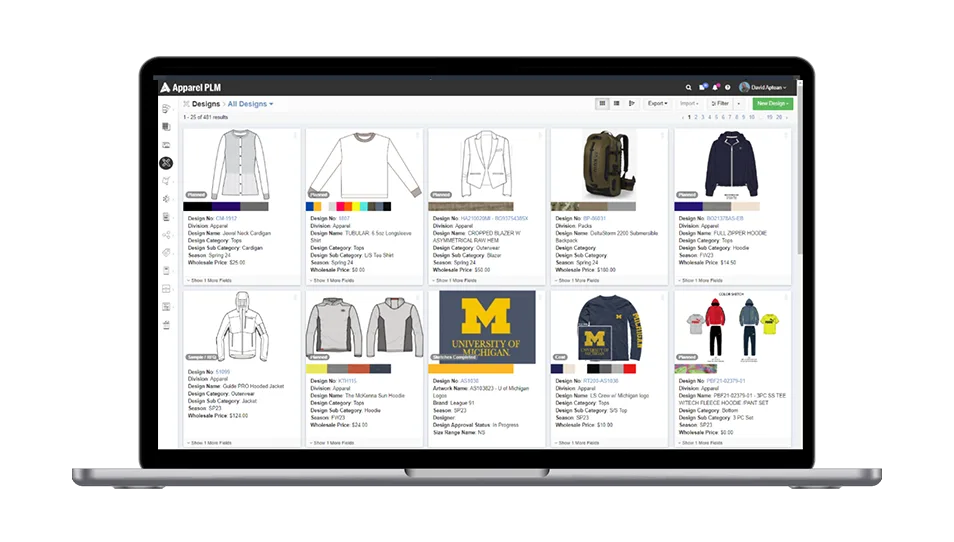
The Ultimate Guide to Apparel ERP: From Concept to Consumer
Considering an ERP to conquer the challenges facing your apparel manufacturing business? Our guide has everything you need to get started—check it out now.
Vertical AI: What It Is, Why It Matters and How It Works in Practice
Learn what vertical AI is, how it differs from horizontal AI, and why industry-specific AI outperforms generic tools in manufacturing, logistics and more.

How To Evaluate Apparel ERP Systems When It’s Time to Upgrade
Considering an apparel ERP upgrade? See what separates the best apparel ERP systems from the rest, and how to evaluate your options with confidence.