
The Ultimate Guide to Apparel ERP: From Concept to Consumer
Only Have a Minute? Here's What You Need To Know
Apparel enterprise resource planning (ERP) software runs styles, sizes, colors, seasons, production, inventory, orders and financials in one system, built around the way the industry actually works. A generic ERP will hold your financials, though it won't hold a style matrix without a lot of custom work.
The gains reach well past the back office—faster speed to market, accurate inventory down to SKU level, one stock pool serving every channel, and pre-season and allocation tools that protect margin long before you reach the markdown.
Shortlist on industry features rather than general capability. Style and color management, seasonal planning, electronic data interchange (EDI) and embedded artificial intelligence (AI) tell you more than a long feature count.
Your apparel ERP works best connected to everything around it—design, production, warehousing and freight all describe the same order. Running those applications on a single AI platform beats maintaining a set of integrations: there's nothing to connect when you add an application, and the AI reads across your whole operation rather than one system at a time.
You're choosing a partner as much as a product. Industry knowledge, a single integrated tech stack and support in the regions you operate in shape the next decade more than any feature comparison does.
Wednesday, August 26, 2026
14 min

By Aptean Staff Writer
Share this report
Featured in this post
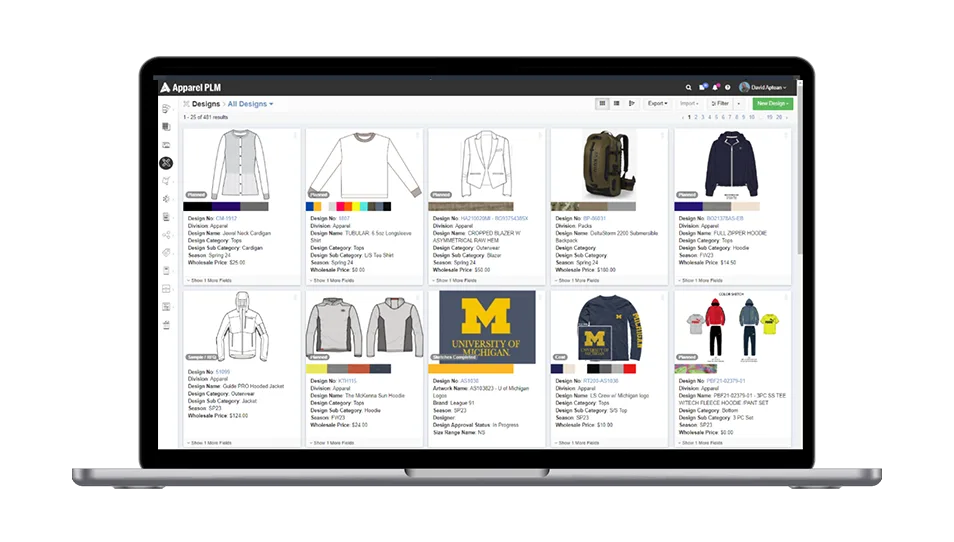
If you run an apparel design or manufacturing business, you need full visibility of every product from its first sketch to the retail rack. Your supply chain is a huge ecosystem and disruption anywhere in it lands back on your team. On top of that, you’re juggling raw material sourcing, planning and design alongside the retailer relationships you’ve spent years building. And that's not to mention sustainability regulations that keeps getting tighter, rising costs and international tariffs.
All of this makes the fashion and apparel industry complex and running your business on manual processes, spreadsheets or a legacy enterprise resource planning (ERP) system will only hold you back. That’s where apparel ERP software comes in—an industry-specific solution designed for brands, manufacturers and wholesalers manages all of these processes, along with warehouse, distribution, accounting and payment functions in one place.
In this guide, we’ll cover what apparel ERP is, what it does and how it benefits your business. We’ll also look at the features worth shortlisting and why connecting your apparel ERP to the systems around it—on a single AI platform—changes what it can do for you.
What Is Apparel ERP, and Why Do You Need It?
Apparel enterprise resource planning software is purpose-built to help fashion, apparel and soft goods businesses manage styles, sizes, colors, seasons, production, inventory, orders and financials in a single system.
All ERPs are set up to do one thing—integrate all departments and functions across a company into a single, unified system. A good ERP should connect and automate internal processes and improve productivity across every department.
But apparel ERP software takes it one step further. With specialized features for the industry, it coordinates your entire business from conception to ordering supplies to manufacturing and even to processing and shipping the finished products. The best apparel software products are built and designed by industry experts and should offer features that solve the unique challenges of apparel businesses.
For example, you need features that support innovation and collaboration at the design phase, full visibility at the planning and ordering phase and automation of critical transactions at the sales and fulfillment phases. The most flexible apparel ERP solutions will even help you manage your manufacturing processes.
The fashion industry is unique—it’s driven by ever-changing consumer tastes and trends more than almost any other. That means you need a software solution that lets you respond quickly to shifting trends and new regulations while staying on top of your sustainability commitments.
You also need to get ahead of supply chain bottlenecks, because today’s consumer expects items to be available anytime, anywhere. With store closures and the growth of online and marketplace selling, finding new omnichannel outlets to sell and distribute your products is a challenge in itself. That requires complete transparency in the value chain, which means integrated data and one source of truth. An apparel ERP gives you all of that.
Now we've outlined what an apparel ERP is, let's dive into what it can do for your business.
Benefits of Apparel ERP Software
As fashion mavens know, styles and trends can change on a dime and a single influencer post can accelerate demand overnight. You need to be ready for any eventuality. Most people know an ERP can automate manual processes, though the benefits of an industry-specific ERP for the apparel and soft goods industry go further. An apparel ERP helps your company stay agile and respond quickly as trends rise and fall.
Here’s how.
Drive Efficiency Across Your Entire Supply Chain. An apparel ERP enables end-to-end visibility and control, which helps you meet sales goals and sustainability initiatives. By choosing a solution with built-in electronic data exchange (EDI), your trading partners can communicate with you in any format and language. Payment tools automate and accelerate the order-to-cash cycle, while warehouse and transportation management modules give you visibility over logistics and inventory.
Keep Inventory Accurate Across Every Style, Size and Color. In the apparel industry, every item can come in various styles, sizes and colors. On top of that, styles will change seasonally and every item must be tracked. Inventory errors have a ripple effect. If you order too much, you might have to mark down inventory to move it. If you order too little and can’t fulfill an order, you risk that customer relationship. Apparel ERP solves those issues with built-in warehouse management and specialized inventory management tools. It coordinates with back-end accounting processes, so your retailers can pay you instantly and the system updates the inventory accordingly.
Increase Speed to Market. With an apparel ERP, you get your products to market faster, with less money and using the resources you already have. When paired with your product lifecycle management (PLM) system, you get real-time data on cash flow, inventory and production status. Your sales team can commit to accurate launch dates, your accounting team can plan spending and procurement can time purchases, with nothing sitting waiting on someone else's forecast. Delays start coming from creative decisions rather than planning gaps.
Innovate Faster and More Efficiently. When your apparel ERP is integrated with an integrated PLM system, everyone works from the same live product record. No waiting days for a supplier to confirm a fabric spec or a factory to weigh in on a prototype option. That gives you more room to test new materials, iterate on styles and catch issues in the sample stage before they become costly mistakes on the production floor.
Protect Your Margins Through the Season. Apparel margin gets decided long before the markdown. An apparel ERP puts pre-season booking data, demand planning and allocation tools in one place, so you can commit to production with better information and move stock between channels while there’s still full price to be had. When a style stalls, you see it in time to do something about it rather than at the end-of-season review.
Sell Across Every Channel Without Adding Complexity. Wholesale, your own retail, ecommerce and marketplaces each come with their own order formats, delivery expectations and returns behavior. An apparel ERP holds them all against one inventory pool, so a sale in one channel updates availability everywhere. Integrations with ecommerce platforms and B2B wholesale portals keep the order data flowing without anyone re-entering it by hand.
Features to Look for in Apparel ERP
Not all apparel ERPs are created equal. An out-of-the-box solution might have some of the features you need, but an industry-specific ERP, created by people who know the fashion industry, will always be a better fit. When you’re talking with providers, here are some important features to look for.
Digital Document Management. From bill of materials (BOM) at the design phase to retail-specific labels once the products go to the stores, you need full transparency and access to every document.
Visual Assets Manager. Your sales and design teams need detailed information about every piece. It should have built-in, style-based image libraries that show clear pictures of every item, along with pertinent details.
Electronic Data Interchange (EDI). A necessity for any enterprise in the industry. Most major retailers will require you to have it before they will do business with you.
Materials Requirements Planning. This type of feature helps you manage import and manufacturing plans, improves the accuracy of your buy plans and helps you manage inventory levels and track deliveries.
Style, Color and Size Management. A single style can generate dozens of stock-keeping units (SKU) once you account for colors, sizes and fits. Look for a style matrix that holds all of it at SKU level, so your team can see orders and inventory by style, color and size on one screen instead of piecing the picture together from three reports.
Seasonal Planning and Allocation. Your ERP should capture pre-season bookings, manage in-season replenishment and track sell-through as the season runs. Allocation tools matter just as much, because being able to redirect inventory between channels and accounts mid-season is how you protect the margin you planned for.
Embedded AI and AI Agents. Ask providers how AI works in their system rather than whether it’s there. The best systems let anyone on your team ask a plain-language question about sell-through or open orders and get an answer back in seconds, without building a report first. They also flag at-risk orders and slow-moving styles before they cost you margin, with AI agents that pick up routine work such as matching a substitute style when the original is unavailable.
Omnichannel Order Management. Check what’s already built for the channels you sell through—ecommerce platforms, B2B wholesale portals, marketplaces and third-party logistics providers—rather than what could be built later at your cost.
Integrating Apparel ERP With Your Wider Systems
Your apparel ERP doesn’t run your business on its own. An apparel supply chain works at its best when data moves between systems without anyone carrying it across, so the software you run around your ERP matters almost as much as the ERP itself.
Which Systems Should Your Apparel ERP Connect To?
Start with the three that touch your product every day. Product lifecycle management (PLM) software holds the design, specification and costing work that happens before anything reaches production. Your apparel ERP takes the style on into planning, buying, inventory and order management. Shop floor control (SFC) software reports what’s happening in production in real time.
When those three share the same data, a color change signed off in PLM reaches the style master and the cut plan without a spreadsheet in between. A line running behind on the floor shows up against the orders it affects rather than in a status meeting the following week.
From there the picture widens. A warehouse management system (WMS) controls what happens between goods-in and dispatch. A transportation management system (TMS) covers the freight moving product between your suppliers, warehouses and customers. EDI handles the transactions your retail partners require. Each of those systems holds data the others could use, and most apparel businesses find that out the hard way when a delayed container only reaches the sales team after the customer has already called.
Why an AI Platform Gets More From Your Apparel ERP
Point-to-point integrations of all the above systems will move your data around your business. They also leave you with a set of connections to maintain, each one built at a different time by different people—introducing additional risk, management and expense.
Running your applications on a single AI platform changes the arrangement. Your solutions sit in one environment on a shared data foundation, so there’s nothing to integrate when you add another application later.
It also changes what the AI can do for you. AI that reads only your ERP can tell you what your ERP knows. AI that reads across product development, production, inventory, orders, warehousing and freight can tell you an order is at risk because of a container that hasn’t cleared, then point you to the style you could substitute. Industry-aware, vertical AI goes further again, because a model that understands seasons, style hierarchies and pre-season commitments asks better questions of that data than a general-purpose one.
And, best of all, the most advanced AI platforms come with a range of valuable capabilities. For example, AI agents that can flag at-risk orders, propose substitutes style and update the plan across your applications while your team is still reading the alert.
How To Choose the Right Apparel ERP Vendor
We've covered what an apparel ERP is, what it does for your business and the features worth shortlisting. The last question is who you buy it from. You'll live with this decision for the best part of a decade, through implementation, upgrades, new channels and whatever the next few seasons bring—so the vendor matters as much as the software. Here's what to weigh up alongside the feature list.
Real Apparel Expertise, Not an Industry Wrapper. A generic ERP won't work for you—it simply won't have the functionality you need, and configuring it into something that does will cost you time and budget you'd rather spend elsewhere. Ask which parts of the system are native to apparel and which are third-party add-ons or custom work. Then ask the vendor to talk you through a chargeback dispute, a pre-season order book or a size-run split. If the answer sounds generic, you'll spend the project teaching them your business. A vendor that already understands your operational and market challenges arrives with opinions worth hearing.
A Secure, Cloud-Based Platform. Your team works from the design studio, the factory floor, a trade show stand and a buyer's office, often in the same week, so cloud access isn't a nice-to-have. Ask how the system is hosted, what uptime the vendor commits to and which security certifications they hold, such as SOC 2 or ISO 27001. Ask how updates reach you too—a cloud system that still needs a project every time it upgrades isn't giving you much of the benefit.
An AI-First Approach, Not a List of AI Features. Every vendor has AI on the roadmap now, so the question is where it sits. AI added to a screen answers questions about that screen. AI built into the platform your applications run on can read across product development, production, inventory, orders and freight at once. Ask what data the AI can see, whether it understands apparel concepts such as seasons, style hierarchies and pre-season commitments, whether its agents can act on what they find or only report it, and how your data is handled and kept separate from anyone else's.
One Vendor Across Your Core Systems. Look at what else the vendor covers—PLM, shop floor control, EDI, warehouse and transportation management. A single connected tech stack tends to integrate more seamlessly and create fewer data silos than stitching together solutions from different providers. It also means one contract, one support line and one team who knows how your data moves end to end. When something breaks, nobody gets to point at the integration.
Experts in Your Regions. Apparel businesses rarely operate in one market, and the detail differs everywhere—EU sustainability and extended producer responsibility rules, US customs and tariff classifications, local tax and labeling requirements. Check that the vendor has implementation and support people in the regions you operate in, working in your languages and time zones. A support ticket that waits overnight for an answer costs you a shipping day.
An Implementation and Support Model You Can Picture. Ask who does the work—the vendor's own consultants or a subcontractor you haven't met. Ask what data migration involves, who owns testing, what training your team gets and what support looks like the week after go-live rather than during it. Then ask for references at your size and complexity, and talk to them without the vendor on the call.
Putting the work in up front to choose the right solution, and the right partner, for your industry is what makes the difference. If you’re at that stage already, our guide to evaluating apparel ERP systems covers what to compare and how to weigh it up.
Dressed for Success With Aptean Apparel ERP
Industry attitudes and consumer behaviors have changed and your business has to change with them. You’re serving traditional retail partners and digital shoppers at once, holding margin while lead times shorten and environmental regulations tighten. Adding another spreadsheet or another disconnected tool to the pile won’t help with any of this.
That’s where we come in. Aptean Fashion & Apparel is our apparel ERP for mid-sized and large brands, wholesalers and manufacturers, is built around styles, seasons and the SKU complexity that comes with them. It’s delivered on AppCentral, our AI platform, where it connects your apparel PLM, shop floor control, EDI, warehouse and transportation management solutions on shared data. Aptean Intelligence runs across every one of them, answering plain-language questions from your teams and flagging what needs attention before it costs you.
More than the software, our team knows how apparel operations run—the pre-season commitments, the chargebacks, the reorder that has to ship this week. That knowledge shapes how we configure the system with you and it stays with you afterwards, through onboarding, training and support. Whatever the next few seasons bring, you won’t be working it out alone.
Ready to see what apparel ERP looks like in practice? Request a demo and see how Aptean’s solutions can work for your operations.
Or want to explore the software for yourself first? Take our free product tour to see how style data, pre-season orders and in-season decisions come together.

By Aptean Staff Writer
Related Articles
Top 4 Reasons Your Apparel Manufacturing Company Needs Shop Floor Control Software
Understand how shop floor control software supports visibility, efficiency, and better production outcomes in apparel manufacturing.

PLM: The Solution You Didn’t Know You Needed
From what it is, to how it works, read our blog to understand PLM software – the solution that unifies your product processes from conception to disposal.

What to Look for When Selecting Apparel Decorating Software
Searching for an ERP software solution for your apparel decorating or promotional products company can seem overwhelming. Let us help.