
Supply Chain Planning Software That Closes the Gap Between Signal and Decision
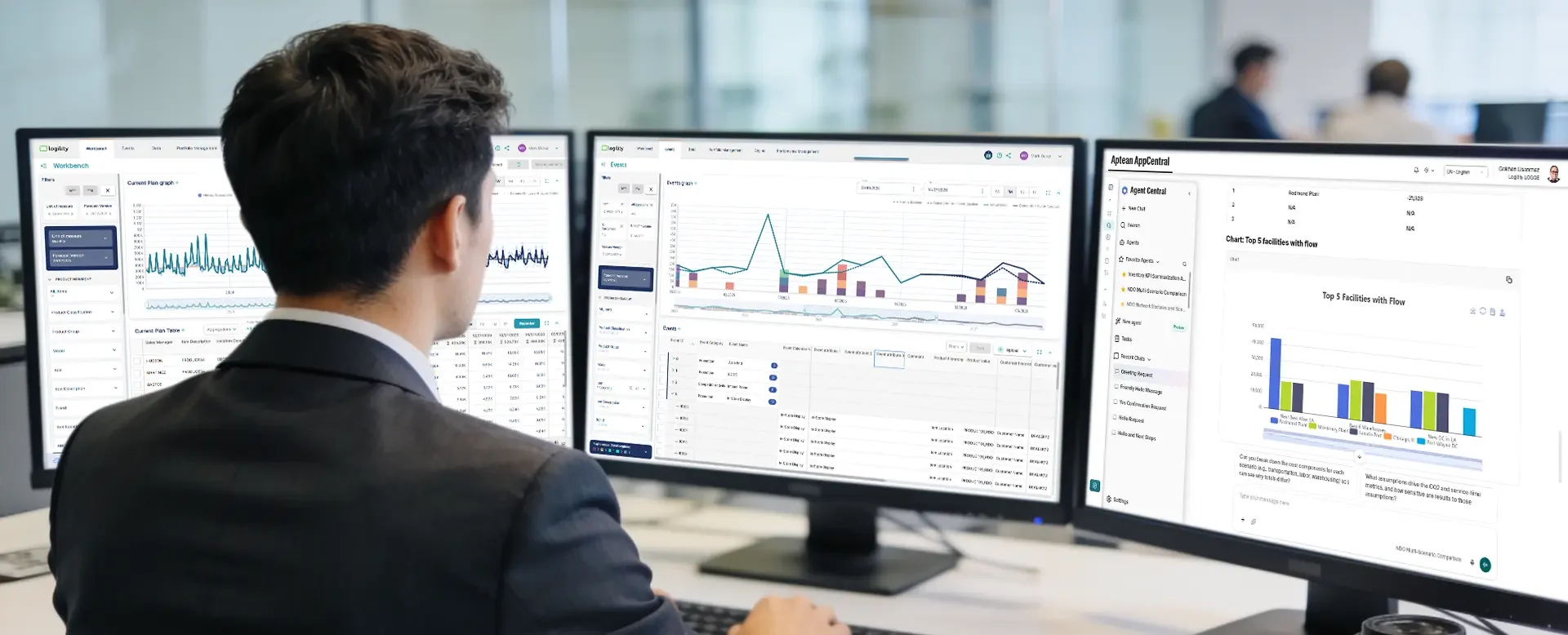
Demand shifts faster than traditional planning cycles were designed to handle—by the time a plan is finalized, the conditions behind it have already changed. Aptean’s supply chain planning software integrates demand, supply, inventory and network planning with artificial intelligence (AI) that continuously senses shifting conditions and adjusts the plan to match. That enables your team to cut inventory while improving service levels and fill rates.

Valued by Customers

"Our use of the demand planning feature has reduced forecast error by over 20%, becoming the cornerstone of our planning process."
Simon Sterck, Chief Operating Officer, SERAX
Recognized by Analysts

Aptean (Logility) Named a Leader in the 2026 Gartner® Magic Quadrant™ Reports for Supply Chain Planning Solutions: Process Industries and Supply Chain Planning Solutions: Discrete Industries
Recognized for Completeness of Vision and Ability to Execute

Aptean awarded IDC’s 2026 SaaS Supply Chain Management Customer Satisfaction Award
Nearly 2,900 companies rated the supply chain software they use every day. Aptean placed in the highest-scoring group.
Capabilities That Cover the Full Scope of Supply Chain Planning
Your planning operation covers more ground than any single tool was designed to handle—demand, inventory, supply balancing, network optimization and cross-functional alignment all require dedicated capability. Our software gives each function what it needs and keeps them all running from the same continuously updated source of truth.
Demand Planning
Static forecast models make decisions based on what the market looked like last quarter. Ours continuously adapts using real-time signals from promotions, seasonality, channel trends and market shifts. Model selection is determined automatically by product and location. Your planners can see exactly what's driving each number, ask questions of your business data in plain language and identify emerging demand shifts before they affect service levels.
Supply and Inventory Planning
Most supply plans are handed off already needing rework before they're executable, creating a delay that costs time and creates misalignment across teams. Our planning engine converts demand signals directly into constrained supply plans that reflect actual capacity, vendor resources and labor availability. Automatic inventory optimization then rebalances stock levels across your network to keep service, working capital and cost in equilibrium as conditions change.
Network Design and Optimization
Network decisions made on outdated data lock in cost and risk simultaneously. Our solution monitors for disruption, keeps constant watch on tradeoffs and provides scenario recommendations your team can compare and AI can act on within your guardrails. What previously required weeks of offline analysis can be completed in hours, with tradeoffs across cost, service and risk visible before any commitment is made.
Sales and Operations Planning and Execution
When demand, supply and finance teams operate from different versions of the plan, sales and operations planning becomes a reconciliation exercise rather than a decision-making forum. Our system keeps every function aligned on a single, always-current plan—so scenario conversations lead to faster alignment and commitments rather than more data collection. Between planning cycles, sales and operation execution keeps everything in step even as conditions shift.
Supply Chain Planning: Adapt At the Speed That the Market Moves
Every commitment you make to customers, production run you schedule and dollar tied up in inventory traces back to a planning decision. When markets shift as fast as they do now, a static plan can’t keep up. Your solution needs to move as fast as the business it’s protecting.


What Business Outcomes Can Advanced AI-Equipped Supply Chain Planning Deliver?
The results show up first in how your staff spend their time. Planning cycles shorten dramatically as AI handles routine decisions automatically, freeing planners for higher-value work. Real-time demand visibility boosts forecast accuracy while inventory carrying costs fall as the system continuously optimizes stock levels. Freight and production costs drop as network decisions are grounded in current cost-to-serve data rather than last cycle's assumptions. Most notably, your team spends less time on data prep and more critical judgment calls.
What Planning Teams Want To Know
Our full supply chain planning suite touches everything from demand sensing to network design, so the questions get specific fast once you're evaluating real fit for your own operation. Here's what comes up most once teams move past the overview and start digging into the details.
If your team is still planning in spreadsheets, you may be seeing gaps in version control and scenario modeling speed. Worse still, the time between when the plan was built and when it's acted on inevitably leads to misalignment. Aptean’s supply chain solution manages data collection and updates recommendations in real time using your operational data. As a result, most teams are able to reduce planning cycle times and recover the hours previously spent maintaining and reconciling the spreadsheet.
Absolutely. Our solution keeps both your sales and operations planning (S&OP) and sales and operations execution (S&OE) processes running via one shared, always-current plan. Now demand, supply and finance can stop reconciling three versions of the truth and start deciding from the same numbers.
"What if" conversations with AI assistants help you surface cost, service and margin tradeoffs in minutes instead of the weeks a spreadsheet-driven cycle takes. Meanwhile, execution stays aligned as conditions shift between meetings. So your S&OP KPIs reflect what's actually happening, not what was true when the deck was last built.
Sure does. The multi-echelon inventory optimization (MEIO) functionality of our software balances service levels, working capital and cost across every tier of your network, raw materials through finished goods. It does so as conditions change, in real time, rather than optimizing one location at a time, so the impact is immediate and ongoing.
As lead times, costs and service targets shift, inventory and supply rebalance automatically within the guardrails your team sets. Most planning teams see carrying costs fall 20–30% once inventory stops being managed location by location and starts being managed as one connected network.
Good Reads for Supply Chain Planning Leaders
The forces reshaping supply chain planning move fast, and that will only be magnified with AI in the picture. Our blog brings expert analysis, practical guidance and real-world context on the trends and challenges that matter most to planning teams.
Vertical AI: What It Is, Why It Matters and How It Works in Practice
Learn what vertical AI is, how it differs from horizontal AI, and why industry-specific AI outperforms generic tools in manufacturing, logistics and more.

Agentic AI vs. Generative AI: What Different Types of AI Mean for Your Business
Learn the difference between agentic, generative and predictive AI—and how to use them together to improve efficiency, forecasting and automation.

Succeeding in Food Supply Chain Management with Specialized Solutions
The answer is surprisingly simple: equip your business with the right tech. Read on to discover how specialized ERP and TMS solutions can optimize your supply chain.
Start Planning Smarter Today
Discover supply chain planning software that acts on real-time signals, not last cycle's assumptions.