
What Are AI Agents? A Simple Guide for Business Leaders
Short on Time? Here’s What You Need to Know
AI agents don’t wait for instructions. They connect to your systems, keep an eye on what’s happening and act when something needs attention, working towards goals and within limits you set.
An assistant answers, an agent acts. Assistants respond when you ask, while agents run in the background and step in when certain conditions are met.
Vertical AI agents are built for your industry. They already understand your processes, terms and regulations. In Aptean’s research, 77% of organisations said general-purpose AI tools aren’t enough for complex operations.
Different agents play different roles. Some monitor, some automate repetitive work, some predict what’s coming and some coordinate other agents.
They’re already part of everyday operations. You’ll find them watching production, flagging maintenance issues, tracking supply chain risk, guiding demand planning and supporting compliance.
Starting small works. Pick one clear problem, check your data and keep people in the loop until the results earn more autonomy.
You don’t have to build them yourself. With AI as a service (AIaaS), industry-specific agents are ready to deploy on a connected AI platform, and custom agents can be built around how you operate.
Thursday, 5 November 2026
10 min

By Bob Zwarycz| Director, AI Solutions
Share This Blog
What Are AI Agents? A Simple Guide for Business Leaders
It’s easy to say AI is everywhere. What matters more is where it's changing how work gets done.
Chatbots gave many teams a first look at what AI can do, but the conversation has moved on quickly. New tools, new terminology and bold claims appear every day, making it difficult to separate genuine business value from hype. And for many organisations, there’s an even bigger question: how do you adopt AI without disrupting operations or creating more work for already stretched teams?
AI agents offer one of the clearest answers. Rather than acting as standalone tools, they automate routine processes, connect systems and carry out tasks on behalf of your teams. That makes them a practical next step if you’re looking to move beyond experimentation and put AI to work in your everyday operations. Our view is simple: an agent should recommend before it acts. Give it authority to act on its own only when its recommendations have earned your team’s trust.
Aptean’s 2026 Artificial Intelligence Research, a survey of more than 1,500 business leaders in Europe and North America, found that 98% of organisations are using or implementing AI, but only 46% have it integrated into or essential to their core workflows.
In this blog, we’ll cover what AI agents are, how they work and where they’re already delivering value in real business environments.
What Are AI Agents?
AI agents are systems that can monitor data, make decisions and perform tasks on their own. They don’t just follow instructions. They work towards specific goals, keeping track of what’s happening and acting when something needs attention.
Unlike traditional software that follows fixed, predefined rules, they adapt their behaviour based on data, goals and changing conditions. They’re designed to run continuously so nothing has to wait for someone to notice it.
For example, an AI agent monitoring production data might detect a spike in scrap on a manufacturing line. Instead of just flagging the problem, it could alert the operations team, point to likely causes and suggest what to adjust.
That ability to spot an issue, work out what’s going on and respond is what sets AI agents apart from many other AI tools. And you stay in control. You set the goals and the limits, and you decide which actions need a person to sign off.
How AI Agents Work in Business
In business environments, AI agents plug into the systems where your data already sits. This might include enterprise resource planning (ERP) software, transportation solutions, supply chain management systems or product lifecycle management (PLM) software.
Once connected, they continuously review that information, looking for patterns, anomalies or signals that something needs attention.
AI agents follow a simple loop:
Observe: They collect data from relevant systems, such as inventory levels, machine performance or order activity.
Analyse: AI models evaluate the data to identify patterns or emerging issues.
Decide: They determine the best action based on the rules and guardrails you’ve set and what the data is telling them.
Act: The agent carries out the task automatically or, where a person needs to sign off, recommends the next step.
Many AI agents optionally learn from outcomes, so their recommendations get sharper over time. Because they’re always running, AI agents can help your teams spot issues earlier, respond faster and ease the burden of constant manual monitoring.
AI Assistants vs AI Agents: What’s the Difference?
Many people first encounter AI through assistants like chatbots or copilots. These tools are useful, but they play a different role from AI agents.
AI assistants are prompt-driven. They respond when someone asks a question or needs help with a task.
AI agents work differently. They’re goal-driven, running in the background and stepping in automatically when certain conditions are met.
A simple way to understand the difference:
AI Assistant | AI Agent |
Responds to prompts | Acts with limits you set |
User initiates interaction | System operates continuously |
Completes individual tasks | Manages multi-step workflows |
Provides information | Recommends or acts, based on your approved rules. |
Both have their place. But AI agents take automation further by handling routine operational decisions within limits you set. And the two increasingly work together: you can ask a question in plain language, and an agent can act on the answer.
What Are Vertical AI Agents?
As teams start to explore AI more seriously, one question comes up quickly: how well does this fit the way we work?
That’s where a more specific approach is emerging: vertical AI agents.
These AI agents are designed for a specific industry or operating environment. Instead of general-purpose automation, they focus on the processes, regulations and workflows that shape how your business runs.
The challenges faced by a food manufacturer are very different from those of a distributor or an apparel brand. A general-purpose AI model doesn’t know your lot rules, your shelf-life limits or what a missed delivery window costs you. A vertical AI agent starts with that context, so it asks better questions of your data and spots issues a generic tool would miss. It’s a gap many businesses have already run into: in our research, 77% of organisations said general-purpose AI tools aren’t enough for the needs of large, complex operations.
Let’s take a look at some examples:
Food and beverage AI agents can test different run sequences against your orders and shelf-life dates, then group compatible products so there are fewer allergen cleans between runs.
Apparel AI agents can turn style and spec data into product content for each sales channel, so merchandisers aren’t writing every listing from scratch.
Logistics and transportation agents can watch live shipments against traffic, weather and carrier history and flag a late lorry while there’s still time to rebook the dock.
Equipment dealer agents can check photos of a returned machine for damage and draft a repair estimate from your own pricing.
Because they're built around real industry workflows, vertical AI agents fit the way your teams already work, helping with real decisions and everyday activities. That’s why industry-specific AI is quickly becoming the practical choice: instead of spending months teaching a general-purpose tool how your business works, you start with one that already understands your processes, terms and regulations.
Types of AI Agents and the Roles They Play
Once you start looking at how AI agents fit into your workflows, a few clear roles begin to emerge. Some focus on monitoring, others on automation or prediction, but all are designed to support day-to-day work.
Monitoring Agents: Analyse operational data and flag potential issues. For example, they might track production output, inventory levels or shipping delays and alert your team when something falls outside normal ranges.
Automation Agents: Handle repetitive tasks that would otherwise need manual effort, like processing routine approvals, updating records or triggering workflows when specific events happen.
Predictive Agents: Use historical and real-time data to forecast demand, predict equipment failures or estimate delivery timelines. So your team can respond earlier and plan with more confidence.
Optimisation Agents: Compare different scenarios and recommend the most efficient course of action, such as adjusting production schedules or distribution routes to cut delays and costs.
Coordinating Agents: Manage several agents at once, passing information between them so a multi-step process runs from start to finish.
Together, these types of AI agents help teams move from reacting to problems to spotting them earlier and acting sooner. All while optimising everyday processes so fewer issues arise in the first place.
AI Agents for Business: Where They Make a Difference
Knowing the types of AI agents is useful. Seeing where they fit is what makes the case. In most operations, the real cost isn’t the problem itself but how late someone notices it. By the time a report lands or a customer calls, the window to act cheaply has often closed. AI agents work in that gap, in the day-to-day moments where work can slow down, drift or get missed.
Here are a few places AI agents can take on routine work:
Keeping an Eye on Production: You don't need to wait for a report to know something's off. AI agents can keep track of output, downtime and waste as it happens, and flag when something starts to drift, so your team can step in before it becomes a bigger issue.
Fixing Problems Before They Stop You: Equipment rarely fails out of nowhere. There are usually early signs. AI agents can pick up on those patterns, giving your maintenance team a heads-up so they can act early, not react under pressure.
Staying Ahead of Supply Chain Disruption: Delays don't always announce themselves clearly. They build over time. By tracking shipment, stock levels and supplier activity, AI agents can highlight risks early and help you decide what to do next.
Planning With More Confidence: Demand shifts. Sometimes gradually, sometimes all at once. AI agents can spot patterns in your sales and seasonality, so you're not guessing what's coming next or overcorrecting when it arrives.
Keeping Compliance on Track: In regulated environments, small gaps can turn into bigger problems quickly. AI agents help keep records consistent, flag potential issues and support traceability, so nothing important gets missed.
That's where AI agents make a difference, not as a layer on top, but as part of your everyday processes, helping your team stay on top of what’s happening.
How To Start Using AI Agents in Your Business
Most teams don't begin with a big rollout. They start small, prove the value and build from there. Here’s how to deploy AI agents without disrupting the workflows your teams rely on.
Start With One Clear Problem: Look for the parts of your operation that need constant monitoring or frequent decisions, like scrap rates, stock levels or late shipments. That’s where an agent can take on routine work fastest. Before anything goes live, benchmark where you are today and agree how you’ll measure success.
Check Your Data: An agent is only as good as the information it can see. Make sure the systems involved are connected and the data is reliable before you switch anything on. A platform where your applications already share one data foundation makes this much easier, because there’s nothing extra to integrate before agents can get to work.
Decide Whether To Build, Buy or Partner: Building AI agents in-house takes data science skills, infrastructure and ongoing maintenance. Ready-made, industry-specific agents get you started faster, with less risk and no additional pressure on your team. If you want more support, some providers will work alongside you to build agents around your specific business goals and manage them as a service going forward.
Keep People in the Loop: Start with agents that recommend actions, then let them act automatically as your team builds trust in the results. And make sure everyone is included from the start with training and buy-in.
Measure, Then Expand: Track what changes against your starting baseline, such as time saved, issues caught early or fewer stockouts. Once the results are proven, extend agents into other processes and departments.
The Future of AI Agents in Business
What started as something teams experimented with is quickly becoming part of how work gets done every day.
As your systems generate more data and become more connected, the challenge isn’t access to information. It’s what you do with it. AI agents help turn that data into action, so your teams can respond faster and stay a step ahead.
That shift only works when everything is connected: data, workflows and AI, all in one place.
With Aptean’s AI-powered AppCentral platform, that’s today’s reality. Your applications—such as enterprise resource planning and logistics software—share one data foundation, so vertical AI agents read across your whole operation, not one system at a time. They monitor, automate and surface what matters, right where work happens.
What’s more, our AI as a service (AIaaS) offering means you don’t need to build models, hire data scientists or manage infrastructure to get started. Industry-specific AI agents are ready to deploy and custom agents can be built around how your operation runs specifically.
Behind the platform are people who know your industry, its regulations, workflows and pressure points, and can help you work out where agents will add value first.
Want to see what that looks like in your industry? Book a personalised demo and we'll walk through where AI agents could fit your operations.
Or want more insights from our Artificial Intelligence Research? Download the full report to see where more than 1,500 business leaders say AI is paying off and where it’s still falling short.

With over 20 years of experience in enterprise IT and cloud architecture, Bob helps our customers modernise outdated ERP systems and eliminate technical debt, and now leads Aptean’s shift from traditional systems of record to AI-driven systems of execution. Prior to Aptean, he spent over a decade helping colleges and universities across the world move their student, financial, HR and CRM systems to the cloud.
Related Content
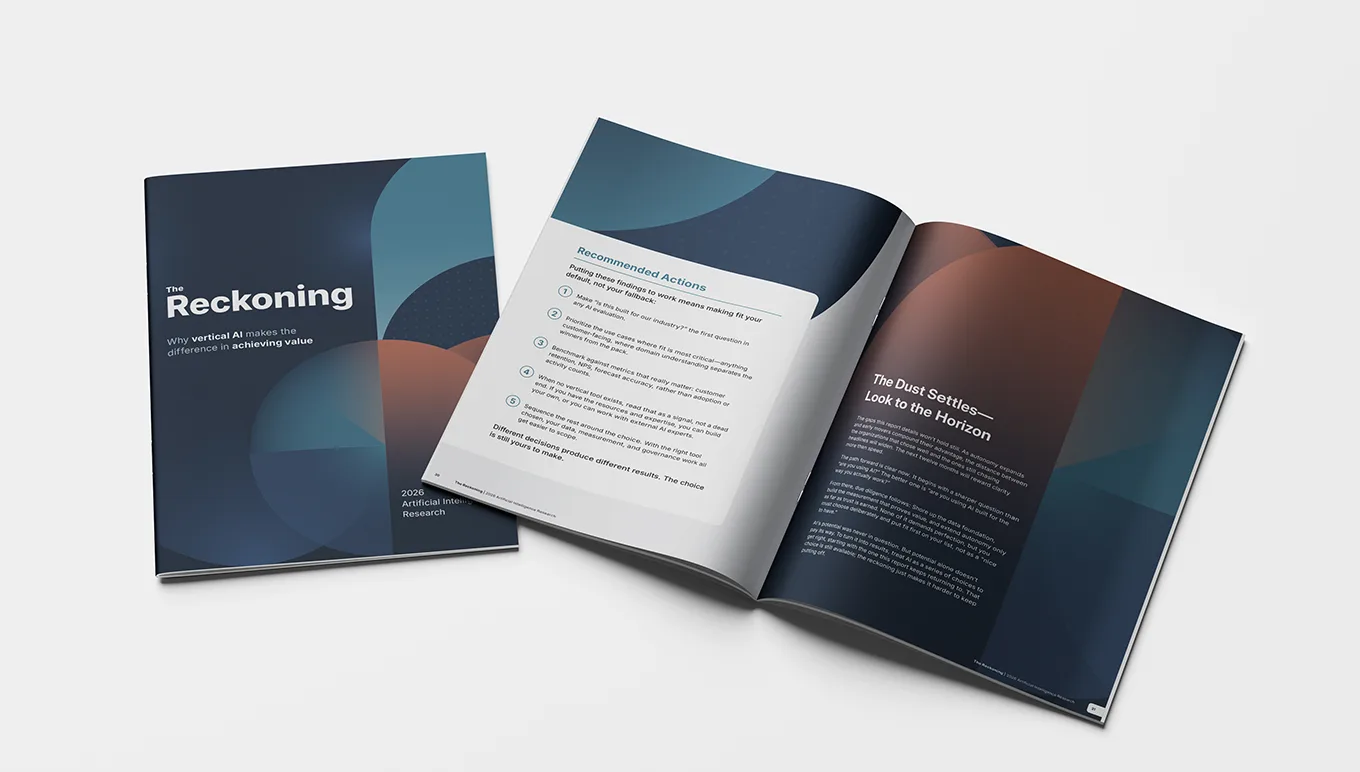
The Reckoning: Aptean’s 2026 State of AI in Business Report
Read the full report on Aptean’s 2026 AI impact survey of 1,500+ business leaders and see why vertical AI is coming out on top.

The 2026 AI Business Trends You Need To Know
AI is moving from hype to execution. Explore the key AI business trends shaping 2026—and what leaders must do to stay ahead.
Biggest AI Adoption Challenges and How To Overcome Them
Explore the biggest challenges organizations face when adopting artificial intelligence and learn practical ways businesses can overcome barriers to successful AI implementation.