
The Reckoning: Aptean’s 2026 State of AI in Business Report
Your 60-Second Summary
The Shift: AI adoption has hit 98%, but real integration and provable ROI haven’t kept pace—and the gap traces back to one early decision: choosing general-purpose AI over purpose-built, vertical AI.
Key Findings:
Adoption Outpaces Integration: 98% use AI, but only 46% have it embedded in core workflows.
Value Is Real, But Unproven: 82.5% say AI's value is clear but not yet fully realized.
Generic Tools Hit a Wall: 77% say general-purpose AI can't handle complex operations; 88% call vertical AI critical or very important.
Infrastructure Is the Weak Link: 81% cite data quality as their top AI barrier.
ROI is Proving Tough: 92% say they need outside expertise to get more value from AI.
Autonomy Is Outrunning Governance: 88% already let AI decide without human sign-off; 36% still lack formal governance.
The Verdict: Businesses pairing vertical AI with general-purpose tools beat general-purpose-only users on all eight KPIs measured, including forecast accuracy (84.4% vs. 76.5%).
Tuesday, July 28, 2026
39 min

By Aptean Staff Writer
Share This Blog
The Reckoning: Aptean’s 2026 State of AI in Business Report
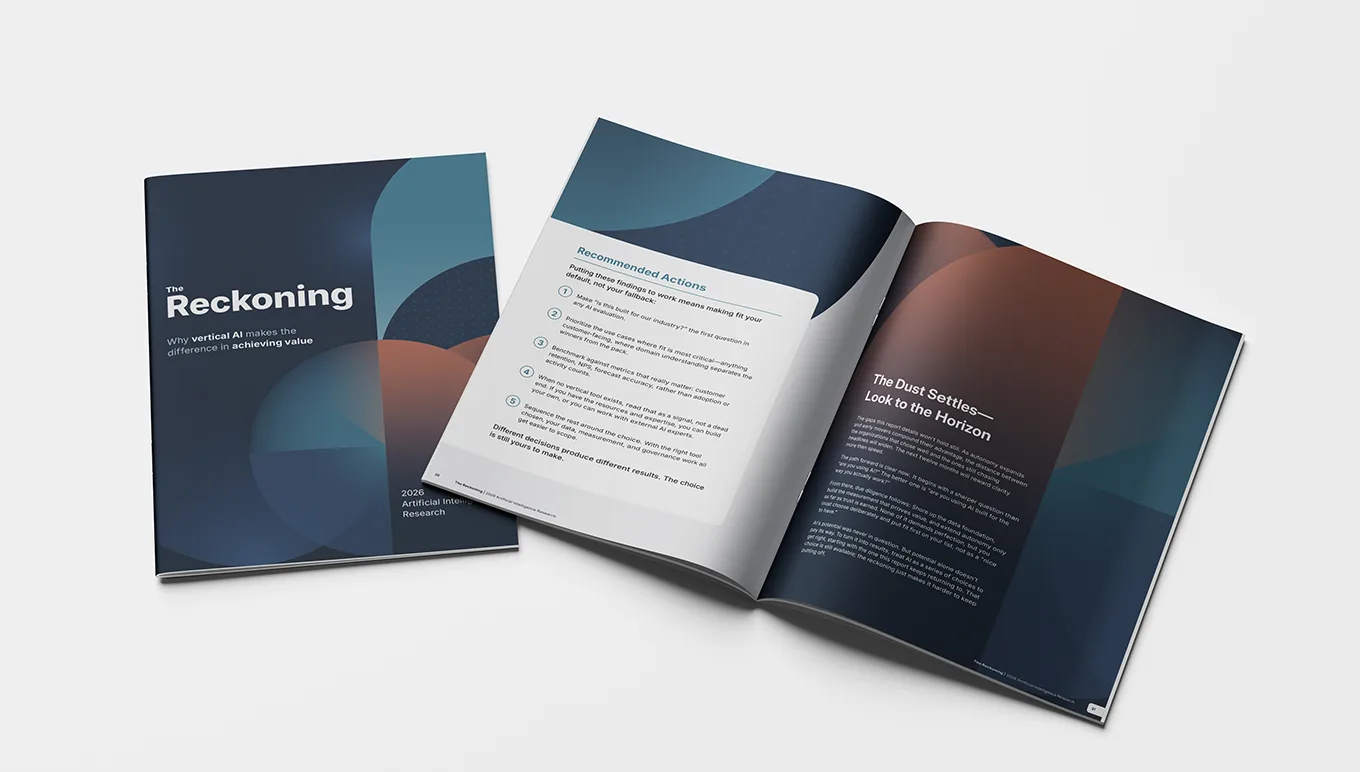
Aptean 2026 Artificial Intelligence Research: An AI Impact Survey of 1,500 Business Leaders
The artificial intelligence (AI) story many organizations have told over the past two years is one of enthusiasm and momentum. Bold investments. Confident announcements. Board mandates to move and move fast.
The faith in technology was not unfounded. The Aptean 2026 Artificial Intelligence Research, our state of AI in business report examining AI opinions and experiences of more than 1,500 business decision-makers, revealed 86% of organizations have improved operational efficiency over the past year.
So, AI is real. The gains are real. And almost no one is turning back.
But spend any time talking with the people closely involved in enterprise AI deployments, and you’ll hear the honest and unabridged version of the story. The organizations reporting gains we surveyed also say AI has yet to deliver full value—and McKinsey's global research1 finds that only 39% of organizations can attribute any profit impact to AI at all, and most put it at less than 5%.
The tools that looked so promising in the pilot are showing their limits in production. And some of the companies that moved fastest are now sitting with the most uncomfortable questions: Why can’t we scale this? Where is the ROI? And did we choose the right tools to begin with?
This is a reckoning. AI hasn’t failed, but the gap between what was promised and what was delivered is impossible to ignore.
Fortunately, what the data beyond the headlines reveals is encouraging. The organizations getting the most from AI have something in common that the industry is just now coming to understand: They didn’t just adopt AI; they chose tools built for their industry, their data, and the way their operations actually run.
This reckoning isn't the end of the story. Far from it. It's a clarifying moment. It forces an honest conversation about what AI transformation actually requires, and it challenges what success looks like. Because AI is worth it—you just need to approach it purposefully, starting with clear objectives and tools that are truly equipped to help you achieve them.
88% say purpose-built AI is very important or critical.
About This AI Impact Report
The Reckoning draws on the Aptean 2026 Artificial Intelligence Research, a multi-region AI impact survey of how organizations are putting AI to work—where it’s paying off, where it isn’t, and why. Aptean commissioned research firm Vanson Bourne to survey 1,535 decision-makers at businesses with $10 million or more in annual revenue, across six markets: the United States, Canada, the United Kingdom, the Netherlands, France, and Germany. The respondents’ businesses span five industries, including food and beverage; apparel and soft goods; transportation and distribution; discrete and process manufacturing; and equipment dealers.
The participants were business and IT leaders, from the C-suite to management, with visibility into their organization’s AI strategy and direct involvement in its ERP or supply chain systems. The 25-question AI adoption survey explored how they approach AI today, how it’s performing, where it’s falling short, and the metrics they use to judge it. One aim of the research was to test a straightforward hypothesis—that AI built for a specific industry outperforms general-purpose tools—and the findings that follow speak directly to it.
To put context with the numbers, Vanson Bourne also conducted 10 in-depth interviews with leaders across those same sectors and regions, whose firsthand accounts appear throughout this report. Survey findings are significance-tested at the 5% level, and interviewees are quoted anonymously. The research was conducted over three months in H1 2026, as AI development and enterprise deployment pushed forward but also raised critical questions.
Chapter 1 — The Confidence Inventory (AI Adoption Gaps)
Organizations are more honest about their AI gaps than the headlines suggest. But honesty and action are not the same thing.
AI Adoption Gaps: Key Takeaways
Here’s an inventory of where organizations stand, beneath the confident headlines:
Adoption is effectively universal at 98%, but only 46% have AI integrated into or essential to their core work. The majority occupy a wide, shallow middle.
The most candid voices are the believers: 82.5% say AI’s value is clear but not yet fully realized.
The motive was opportunity, not anxiety—83% adopted to compete and move faster, just 17% out of fear of falling behind.
These gaps aren’t a mystery to the people living them. Organizations can name them, and they trace back to earlier decisions. This means they’re fixable.
The narrative says AI adoption is accelerating, and on the surface the data agrees. Non-adoption has become a statistical rarity: 98% of organizations are already using or implementing AI. The market has clearly moved.
But adoption is a scale, not a destination, and it’s where confidence starts to wane. Only 46% of organizations say AI is integrated into or essential to their core workflows. The majority sit in the wide, shallow middle. They’re using AI in a function here or piloting a use case there, but it never gets embedded in core operations. So, the standard headline counts the companies that started, but it says nothing about how far they got.
Organizations know the difference. 82.5% agree that AI's value is clear but hasn't been fully realized yet. That matters, because it doesn't come from skeptics or analysts watching from the outside. It comes from the people who already bought, believe in, and use AI technology to help run their businesses. And they’re telling you they’re not there yet.
82.5% say AI's value is clear but not yet fully realized.
What makes that admission more pointed is ambitions were (and are) so high. When asked what drove them to adopt AI, 83% pointed to opportunity—the chance to move faster, operate more efficiently, and compete harder. Only 17% were driven by fear of falling behind.
So, this was not a market stampeding out of anxiety. It was a market reaching for something real. Execution is where it gets complicated.
You can hear these threads in how operators describe their own journeys. Consider a mid-market UK fashion and apparel brand that began using AI not as part of any strategy, but to plug a hole.
"We unfortunately had to let go of one of our accessory designers," a senior manager explained. "So we basically used AI as the first stage designer."
The tools were never rolled out formally, and no training was provided.
"They basically came about through my own research," she said. "I had to figure it out myself." Real value, found by accident and owned by one person, with no foundation underneath it.
Then there is a two-speed reality inside a single company. At a large U.S. apparel manufacturer, a senior manager said that a purpose-built forecasting tool has the company "significantly better off" in terms of forecasting demand at the SKU level across thousands of products. But the general-purpose sales assistant running alongside it tells a different story.
"The implementation for sales, I would say, has had mixed results," he noted, adding it’s useful for new hires with basic questions, but far less so for anyone who already knows the work.
Same company, same year, two completely different outcomes. And the variable wasn't effort on behalf of the employees; it was the fit of the tool.
That’s not to say AI can’t serve the sales and marketing department. The CEO of a small UK equipment manufacturer grew top-line revenue 23% in a year while leads rose only 9%, crediting AI-assisted content and conversion for the gap.
But that same leader is candid about getting it wrong early: a first website bot "was probably an example of bots being done really badly," he admitted, and "probably turned customers away." Looking back, he wishes the company had started sooner, investigated options more thoroughly, and pushed past its own skepticism faster.
That’s the honest baseline. Adoption is nearly universal, belief is high, and there’s real value to be had. But integration is shallow, value is slow to come, and much of what's working was stumbled onto rather than designed.
The organizations in this study are not in denial about their gaps; they can name them clearly. But that means the issues the rest of this report examines are not mysteries or bad luck—they’re traceable back to earlier decisions. So you can choose differently if you revisit them and apply the insights from these findings.
AI Integration Depth, by Vertical
Which of the following best describes your organization’s status with regards to AI?
Vertical | Essential to workflows and decision-making | Integrated into workflows and decision-making | In use but not integrated | Exploring or piloting | Not implemented/no strategy |
Average | 20% | 26% | 35% | 10% | 7% |
Transportation & distribution | 17% | 28% | 40% | 8% | 7% |
Food & beverage | 23% | 19% | 33% | 12% | 11% |
Equipment dealers | 21% | 31% | 33% | 8% | 5% |
Process & discrete manufacturing | 15% | 24% | 41% | 12% | 7% |
Apparel & soft goods | 24% | 27% | 29% | 13% | 7% |
Figures are rounded, may not total 100% across each vertical.
Recommended Actions
If you recognize your organization is in the shallow middle of AI integration, here’s how to start incorporating it more deeply:
Map where AI lives. Sort every use case from “someone’s experimenting” to “the business depends on it,” and be honest about how much sits at the shallow end.
Separate adoption from value. For each use case, name the business outcome it has moved, not just the task it performs.
Look for the divide inside your own organization. Where is a purpose-built tool outperforming a general one inside your organization, and what does that tell you?
Capture the accidental wins. Document the ad hoc successes, and the people quietly running them, before knowledge walks out the door.
Pick a few use cases to deepen. Choose where to move from shallow to integrated and resource those deliberately, rather than spreading your resources too thinly.
Done well, this turns a bunch of experiments into a short list worth betting on.
Key Terms: What Is Vertical AI?
Vertical AI is purpose-built for a single industry or function and trained on the data, terminology, and compliance rules specific to that domain. In contrast to general-purpose, or “horizontal,” models that are built to do a little of everything, vertical AI narrows the scope to do one industry’s work well. That focus is what makes it more accurate, less prone to hallucination, and able to plug directly into the software stacks a business already runs. Alternative terms include “industry-specific AI,” “purpose-built AI,” and “specialized AI.”
Chapter 2 — The Wrong Tool Problem (Vertical AI vs. Horizontal AI)
The AI most organizations chose first was the AI most available, not the AI most appropriate.
Vertical AI vs. Horizontal AI: Key Takeaways
Why have big investments in AI underdelivered? The pattern is hard to miss once you see it:
Most reached for the most available tool rather than the appropriate one. Now 77% say general-purpose AI can’t handle large, complex operations.
The appetite for the alternative is near-unanimous: 88% call purpose-built, industry-specific AI critical or very important, and 99% say it matters at least somewhat.
When the sanctioned tools don’t fit, people go around them and seek alternatives. 40% use AI; their organization never formally approved.
When you trace the gaps in AI’s promise and performance back to their roots, you find a handful of connected weaknesses. One choice sits upstream of the rest, though, and it’s what kind of AI a business brings in to begin with. Get it right, and the other barriers get shorter. Get it wrong, and they all grow taller.
But over the past two years, as organizations went looking for AI, most reached for what was right in front of them: the general-purpose platforms that were broadly marketed, easy to pilot, and already sitting in everyone's browser. It was a choice made quickly, before the evidence we have today existed.
Turns out, not everything “available” is actually “appropriate.”
The data reflects that fact. More than three-quarters (77%) of organizations say general-purpose AI tools are insufficient for the needs of large, complex operations. And the preference for the alternative is close to unanimous: 88% say purpose-built, industry-specific AI – or vertical AI - is critical or very important to them, and 99% say it matters at least somewhat. More than a mild preference, that’s indicative of a market that has learned something.
77% say general-purpose AI is insufficient for large, complex operations.
And what they've learned shows in why they value purpose-built tools. The top reason isn't a smarter algorithm—it's easier in integration with the systems they already run, like ERP and supply chain platforms (named by 47% of those for whom industry-specific AI is critical or very important). Next, come more relevant and accurate outputs for their industry (42%) and better strategic guidance from vendors who understand their sector (40%). More than a third (38%) point directly to stronger ROI than general-purpose tools deliver.2
The pattern is hard to miss: Fit beats horsepower.
You can hear the wrong tool problem most clearly in the instances where a general-purpose assistant hits a wall it was never built to cross. At the large U.S. sports apparel manufacturer, the wall is the company's own core systems.
"We're still aiming to enable real-time information from our ERP into our instance of ChatGPT, so the agent can answer questions that would normally require a person to log into the system," the senior manager there explained. Until that connection exists, the tool can only ever answer half of the question.
Some organizations are already correcting course. A mid-market U.S. manufacturer uses ChatGPT and Copilot freely for the generative work they're good at, like drafting emails and summarizing contracts. But for the work that actually defines the business, they went a different way.
The company’s supply chain leader said a specialist firm was brought in, and from there the team “whittled down from about 50 or 60 of their agents." The end result was a custom demand-planning agent, because the off-the-shelf assistants couldn't handle the complexity. That's the correction happening in real time.
Sometimes the fault line runs straight through a single company. A U.S. manufacturing enterprise has AI working well in customer relationship management, where it summarizes feedback and runs sentiment analysis across markets. But the same organization can't make it work for demand planning.
"We are not able to implement AI in complex environments where we have a lot of variables and a lot of product lines," they said. "There, we are not getting consistent results."
Simple and repetitive tasks, the general tools handle well. Complex and industry-specific tasks, they don't.
Roughly 40% of respondents report using AI tools for work independently, without formal approval from their organization (known as “shadow AI”). That figure holds almost exactly across seniority levels; C-level and senior leaders do it at the same rate as mid-level and junior management. So the people responsible for setting the rules are working around them just as often as everyone else.
It’s tempting to file that under governance, which gets its own chapter. For now, the more pressing concern is what it says about fit. When the sanctioned tools don't do the job, people quietly go find ones that do. Shadow AI isn't only a compliance problem. It's the workforce saying the official toolset doesn’t actually meet their needs.
And to formally add and authorize a new AI tool, organizations must be able to justify the investment required. When asked which factors most influence how they secure budget for AI initiatives, respondents named a clear business case with quantified ROI (57%), alignment with strategic goals (52%), and ease of implementation (49%). Shadow AI spreads as quickly as it does because it bypasses every one of those criteria.
So, the “wrong tool problem” isn't a story about bad technology. After all, the general-purpose tools work, often impressively, on the tasks they were built for. The trouble starts when you ask them to operate inside the systems, data, and complexity of a specific industry.
Why Organizations Value Purpose-Built AI
What are the main reasons your organization values AI solutions that are purpose-built for its specific industry or vertical?
Reason | Share (% chosen reason) |
Easier/improved integration with existing systems | 47% |
More relevant and accurate outputs | 42% |
Better strategic guidance | 40% |
Better fit with regulatory or compliance requirements | 39% |
Stronger ROI | 38% |
Faster time to value | 30% |
Competitive pressure | 30% |
Reduced need for customization | 23% |
Share of respondents that chose each reason. Respondents could select multiple reasons; figures do not total 100%.
Most Influential Factors to Secure AI Budget
Factor | Share (% chosen factor) |
Clear business case with quantified ROI | 57% |
Alignment with strategic goals / transformation | 52% |
Ease and speed of implementation | 49% |
Share of respondents that prioritize the factor. Respondents could select multiple factors; figures do not total 100%.
Shadow AI Usage by Country
Country | % (reporting shadow AI usage) |
France | 50% |
Netherlands | 47% |
Canada | 43% |
Germany | 39% |
USA | 38% |
UK | 30% |
Share of respondents who use AI tools without formal organizational approval.
Key Terms: What Is Shadow AI?
Shadow AI refers to AI tools employees adopt and use on their own—without their organization’s approval, security review, or visibility. It's not necessarily malicious; most resort to it as a workaround when sanctioned options are unavailable or otherwise feel slow or limited. But because these tools operate outside governance frameworks, the data fed into them and the outputs they generate exist in a blind spot. The risks range from intellectual property exposure and compliance violations to strategic decisions based on AI-generated content that hasn’t been audited. Alternative terms include "unsanctioned AI," "unauthorized AI," and "rogue AI."
Recommended Actions
Choosing AI for fit instead of accessibility changes what you’re looking for in a solution. A buyer’s checklist:
Start with the problem to be solved, not the tool. Define your objective before anyone schedules a demo.
Ask the integration question first. Can it reach your ERP and operational systems, or will it only ever answer half the question?
Value fit over horsepower. A model that understands your domain will outperform a more powerful one that doesn’t.
Read shadow AI usage as telling data. Where employees have gone out and found their own tools, you’ve found an unmet need worth sanctioning properly.
Pressure-test the vendor’s industry credentials. Do they bring relevant context on day one, or will they have to learn your business along the way?
Fit is the cheapest thing to get right at the outset, and the most expensive to retrofit later.
Chapter 3 — The Infrastructure Gap (AI Implementation Challenges)
Even the right tool can't overcome a weak foundation. For many organizations, the data and systems underneath are also holding back AI’s value.
AI Implementation Challenges: Key Takeaways
The barriers here are daunting, and nearly everyone hits them:
Data is the first hurdle. 81% say data quality or access is the single greatest barrier to making AI work—ahead of talent, budget, or skepticism.
The integrations are the second obstacle. 82% say integrating AI with their core platforms is a bigger challenge than the AI itself.
And it compounds: 75% agree lack of governance is a major barrier to achieving success with AI solutions.
The right tool gets a business to the starting line, but whether it crosses the finish in no small part depends on the ground it runs on. Even a purpose-built solution can only work with the data it can reach and the systems it can connect to. And for many businesses, that foundation is the weak point—just over 80% of participants say data quality or access is the single greatest barrier they face to successful AI implementation.
The principle is old but still applies: Bad inputs produce bad outputs, regardless how sophisticated the model is. What AI changes is the velocity. A system running on flawed demand data doesn’t produce one wrong forecast—it produces hundreds, automatically, before anyone can course-correct. That can lead to overcommitted orders, missed delivery dates, and approved spend that should never have cleared—the operational price of a shaky data foundation.
Integrations of AI with core business systems is another part of the problem. 82% say integrating AI with their core systems is a bigger challenge than the AI itself. And when they start towards integration the problem compounds: 75% agree a lack of governance as a major barrier to achieving success with AI. Safe to say that’s a settled view across the market, not a fringe worry held by a cautious minority.
82% say integrating AI with core systems is a bigger challenge than the AI itself.
These issues compound and point right back to the wrong tool problem—remember the top reason organizations give for valuing purpose-built AI is easier integration with their systems. So the tool choice doesn't sit apart from the infrastructure problem; it's part of how you solve it.
Of course, the issues that stem from messy technology foundations aren’t new. Fragmented data and siloed systems have been known problems for years, the kind of thing every organization knew it should fix eventually. But AI’s pressing the point. It’s making a quiet, deferrable weakness into the biggest thing standing between a business and the value it was promised.
You can watch that happen in a single failed pilot. At a large U.S. food and beverage producer, the team set out to build an AI-powered commercial promotion planner: a model that would read years of promotional history, pricing, and distributor inventory, then recommend which promotion to run, when, and for how much.
It didn't survive contact with their own data.
"We had too much hope on the data we had," a senior manager admitted. The historical records lived in a legacy ERP full of "very customized, sophisticated tables," but the same data points sat across multiple systems, fragmented in the backend, making them impossible to fully trust.
"It failed right away."
The lesson he took was blunt: harmonize the data first, before running experiments with AI.
An inverse case proves the same point from the other direction. A U.S. food and beverage enterprise built an order anomaly detector that flags when a restaurant's order looks wrong before the truck leaves the warehouse. It worked, and an executive there was clear about why.
"The process is very defined," he said. "All the data is very well defined. Our product data is pretty robust."
Later he reduced it to a principle: "AI needs two things." It needs a very well-defined process, and it needs good data."
What makes this barrier so stubborn is that even the organizations succeeding with AI keep running into it. The senior manager at the large U.S. apparel manufacturer, whose purpose-built forecasting tool was already working well, still named integration as the one thing he'd change.
"Having a clearer view of the systems integration requirements," he reflected, "and more intentional efforts to create those connections to our systems sooner, would have enabled faster progress."
The uncomfortable truth of “the infrastructure gap” is that it rewards work nobody finds exciting: cleaning data, connecting systems, and defining processes are not the parts of AI that make headlines. But it’s part of what separates the pilots that scale from the pilots that quietly die.
The organizations getting consistent value from AI didn't only choose better tools. They also did the unglamorous work of preparing the ground those tools had to grow in.
What’s Holding Back AI’s Value?
Barrier | Share (% agree) |
AI without system modernization is unlikely to deliver full value | 86% |
Integrating AI with core systems is harder than the AI itself | 82% |
Data quality or access is the greatest barrier to AI success | 81% |
Share of respondents who agreed with each statement. Respondents could agree with more than one statement.
Recommended Actions
Before you blame the model, look hard at the ground it’s running on:
Audit your data before you scope the use case. If the inputs are fragmented or untrusted, no model will save you the cleanup.
Map the integration path early. Know which systems the AI has to reach and what it takes to connect them before you commit.
Pick use cases where the process is already well-defined. AI rewards clarity and struggles where the workflow itself is fuzzy.
Fix the foundation first, then scale. The organizations that succeeded saw to their data and systems, then deployed—not the reverse.
Think of purpose-built tools as a leg up to clear these barriers. They’re already shaped to your industry’s systems, which is why integration ranks as their top advantage.
The unglamorous work is what separates the pilots that scale from the ones that quietly die.
Chapter 4 — The Measurement Void (Measuring AI ROI)
Organizations believe AI is working. Proving it is another matter.
Measuring AI ROI: Key Takeaways Belief in AI’s value runs well ahead of the proof for it:
82.5% say AI’s value is clear but not yet fully realized—expectations are still outpacing outcomes.
The metrics most prioritized today are high-level: operational efficiency leads (43%), then cost savings (36%) and decision quality (34%).
The framework for a more complete return on investment is required. 92% say external expertise or support would help them get more from AI, a quiet admission that the discipline to prove value isn’t in-house.
Left to improvise, measurement defaults to whatever’s easiest to count, which is rarely what matters most.
Choosing the wrong tool also amplifies a problem visible in one of this study's loudest findings: More than four in five organizations say AI's value is clear but not yet fully realized. In other words, they believe in it but can't yet show their work. That gap between conviction and evidence is the “measurement void.” A mismatch between general-purpose systems and specialized operations widens it, and that's why so many AI programs feel successful while being impossible to defend from a numbers standpoint. Call it the AI ROI gap.
It’s not that organizations can’t measure any improvements. Nearly all of them track something, and what they do track reveals a lot about what matters. Operational efficiency tops the list of success metrics (named in the top three by 43%), followed by cost savings (36%), and decision quality (34%) as being important in determining the success or failure of their AI initiatives. The intent is clear and the dashboards exist. But there’s no framework that turns those scattered metrics into a case—and that’s the kind of rigor that lets a leader say the investment paid back, and by how much.
Another telling statistic on this front: 92% say outside expertise or support would benefit them in getting more from AI. That's a quiet admission that the capability to build and interpret a measurement framework isn't in the building for most companies. Businesses secured budget and shipped deployments, but the discipline to confirm the return was never staffed with the seriousness the original business case got.
92% say outside expertise or support would help them get more from AI.
Left to improvise, measurement defaults to whatever is easiest to count. For the senior manager at the large U.S. sports apparel manufacturer, that's headcount. Investments get approved when they avoid a hire and stall when they don't, even where the process value is real.
If a benefit came from “streamlining processes but without headcount reductions attached,” he explained, the finance team “isn't able easily to connect the investment with either savings or sales growth,” so the proposal struggles. The easy metric crowds out the meaningful one.
Sometimes the value is real but refuses to appear where conventional ROI looks for it. At a large U.S. manufacturer, AI displaced expensive outside consultants, but the savings never reached the bottom line.
“Right now I wouldn't say we are necessarily saving a lot of money. But it's been a reallocation,” an executive there said. The freed-up money went straight back into GPUs and infrastructure.
“We may be spending the same amount of money, but we're getting a lot more from it.”
On a standard payback calculation, that program looks like a wash. In practice, it's doing five to ten times the work, but because there’s not a framework through which we can observe it, we can’t point to hard evidence of it.
Consider a mid-market U.S. distributor that built measurement in from the start. A cross-functional committee spanning innovation, IT, operations, finance, and the CEO vets every AI investment, and the business holds itself to one clear, sector-specific number: shipments handled per person.
That way, the result isn't ambiguous. In this case, the business’s tool for ingesting bills of lading and customs forms runs above 98% accuracy, and shipments per headcount have roughly doubled. Those numbers work for a payback calculation because they’re a big part of what defines success in the supply chain industry. Shipments per head is one of the metrics that matters most in the logistics world, and because it understands freight documents and customs workflows to begin with, the tool can actually help move it.
Thus, purpose-built AI’s advantage runs deeper than performance alone. It makes performance easier to prove, because it’s built around the numbers that define the business.
The measurement void compounds the barriers that came before it. Fragmented data makes clean measurement harder, and a general-purpose tool hands you little that maps to the numbers your industry runs on.
The organizations that climb out of this hole tend to share the distributor's approach: They decide upfront what single outcome would prove success, and they pick tools close enough to the operation to move it. Proof, in the end, is less about measuring harder than about choosing what to measure and what to measure it with.
Most Important Success Metrics for AI Initiatives
Success metric | Share (% top-three priority) |
Operational efficiency | 43% |
Cost savings | 36% |
Decision quality and speed | 34% |
AI ROI / payback period | 32% |
Revenue generation | 31% |
Share of respondents that say the chosen metric is important for determining the success of AI projects. Respondents could select up to 3 metrics, figures do not total 100%.
Recommended Actions
Make AI’s value provable by building in the methods of measurement from the start:
Decide what would prove success before you build. Name the single outcome that, if delivered, would justify the investment.
Choose metrics that matter in your business, not just the ones that are easy to total. Labor savings are seldom the whole story.
Put a date on return on investment. The strongest programs set a payback window up front and hold the project to it.
Watch for value that hides. Savings reinvested elsewhere or capacity freed for growth won’t show up on a simple cost line.
Favor tools that track your industry’s KPIs natively. When the metric that defines success is built into the tool, proof gets a lot easier.
Without a framework, even real wins stay invisible—and invisible wins don’t get funded twice.
Chapter 5 — The Autonomy Frontier (Agentic AI Governance)
Until now, the wrong tool has cost you money. Here, it starts to cost you control.
Agentic AI Governance: Key Takeaways
AI is already making decisions on its own, faster than the rules meant to govern it:
88% already let AI make at least some decisions without a human signing off, from forecasting to customer-facing calls.
The guardrails lag: 96% say a formal governance framework is required, yet 36% haven’t built one, and 75% call its absence a major barrier.
The stakes change once the human steps out. A general tool’s mistakes used to get caught at review. Running unsupervised in regulated industries, mistakes can mean fines or sanctions.
Even as organizations argued about whether AI was worth it, they started trusting it to make decisions on its own. Across the organizations in this study, 88% already allow AI to make autonomous decisions in at least one area, with no human in the loop. Forecasting and planning is the most frequently AI-automated process, with 49% of businesses allowing giving AI autonomy in that area. Customer-facing decisions are automated by 48% of respondents, and even strategic calls like supplier selection and capacity planning are handed to AI at 42%.
The frontier isn't somewhere on the horizon. Most organizations are already living on the far side of it.
And when an agentic AI tool is chosen off the shelf and forced to contend with complex industry-specific numbers and processes? Poorly fitted tools have delivered weaker results, shakier data, and returns nobody can prove. Pull the human reviewer out, though, and the consequences get much more severe.
Because most of the time, someone’s there to catch and fix a general-purpose tool’s mistakes. But when that tool can act unilaterally, and does so without full context or expert judgment, the results can range from small hiccup to company-wide catastrophe.
Of course, what it costs depends on the decision. The mid-market U.S. distributor uses AI to fill in customs and government forms, and the executive there is clear about the downside. A mistake there could carry “some severe penalties,” he said, and in the worst case “let items that are banned or not allowed within a country go through, or ship something to a country that is sanctioned against.”
The cost of an error like that is measured in fines, seized goods, and regulatory exposure. Not just sub-par KPIs on the dashboard.
And when something does go wrong, who answers for it? Most organizations haven't decided. When asked who would be accountable if an autonomous agent cut the wrong purchase order, the supply chain leader at the mid-market U.S. manufacturer gave an honest, unsettling answer: “In my mind it would be the AI, because there was no person there.”
36% haven't built the AI governance framework they themselves call essential.
His company had approved the criteria for autonomous AI usage all the way up to the CFO and accepted that mistakes would happen, but it had never settled where responsibility actually lands. That question stays open in most places.
Governance should be holding this line, and the data says it mostly isn't. Three-quarters of organizations call its absence a major barrier to AI success, yet more than a third (36%) haven't built a formal framework.
Meanwhile, 96% recognize that AI governance is required. So it’s not that they don’t know; they just haven’t done it.
It's worth being precise about the cause here. That gap is a discipline problem. The wrong tool doesn’t create it, but it does raise the price of the gap. Ungoverned autonomy is risky with any tool, but with a tool that doesn't grasp your domain and processes, the risk increases significantly.
So how do the organizations that extend autonomy responsibly pull it off? They earn it slowly, behind a wall of accuracy. Leaders at two separate logistics businesses arrived at almost the same rule without comparing notes: near-perfect performance, sustained over time, before granting any more independence. A leader at a large U.S. transportation and distribution business wants to see “99% plus” accuracy holding “for a certain time period”—somewhere between six months and a year—before he loosens the reins. The mid-market distributor lets its document tool run with only light oversight because it clears 98% on the forms that matter.
Notice what that bar demands: Hitting 98 or 99% on the work that defines a complex; regulated operation is precisely what general-purpose tools struggle to do. It’s the limitation introduced earlier as the wrong tool problem. A tool has to fit the domain and understand business context before you can trust it to act alone.
The organizations furthest along build that trust on purpose. The large U.S. manufacturer won't let a model check its own work— “you don't have the same AI check its own work; that's a bad idea,” said the business’s executive—so every autonomous output runs through a separate reviewer AI.
The senior manager at the mid-market UK fashion and apparel brand draws the line at brand and creative decisions, because “it's not just numbers, it's emotions that basically sell the product.”
Different industries, but the same rule of thumb: Grant autonomy only in the narrow places where the tool genuinely understands and is well-suited for the work.
The exploration of the frontier up to this point points to one important lesson. Autonomy sits at the top of the stack, resting on every layer below it: the right tool, sound data, and honest measurement. Where those hold, a business can keep handing AI more responsibility as the evidence earns it. Where they don't, it can all fall down.
Where AI Is Allowed To Act Autonomously
Decision area | % (autonomous decisions allowed) |
Forecasting and planning | 49% |
Customer-facing decisions | 48% |
Tactical / operational decisions | 44% |
Strategic decisions | 42% |
Workforce decisions | 36% |
Financial decisions | 36% |
Share of respondents whose organization allows AI to act autonomously in the given area. Respondents could select multiple areas; figures do not total 100%.
Recommended Actions
Treat autonomy as earned, not granted. Consider a staged approach:
Decide who’s accountable before you hand over the decision, not after something goes wrong. If the honest answer is “the AI,” you’re not ready.
Set an accuracy bar to be sustained for a period of time. The organizations doing this well want near-perfect performance sustained for months before they extend trust.
Don’t let a system check its own work. Route autonomous output through independent review, whether it’s a person or a separate model.
Match the leash to the stakes. Reserve the most autonomy for low-risk, repetitive decisions; keep high-consequence calls in human hands.
Draw bright lines around what stays human. Brand, ethics, and any decision where being wrong is catastrophic don’t belong on autopilot.
Lastly, remember fit is a prerequisite. Effective AI autonomy is using a tool that genuinely understands the work it’s trusted to do.
Chapter 6 — The Vertical AI Verdict
Every barrier in this report traces to one choice. Here's what choosing well was worth.
The Vertical AI Verdict: Key Takeaways
Strip away the noise, and the organizations winning with AI share one decision:
They chose to pair industry-specific AI with the general-purpose tools already in play, and it shows in the numbers. Across eight operational KPIs, businesses using both industry-specific and general-purpose AI lead general-purpose-only users on all eight.
The clearest, statistically significant gaps are better net promoter scores (70.6% versus 56.8%), stronger customer retention (78.4% versus 71.2%), and more accurate forecasts (84.4% versus 76.5%).
Fit is the upstream choice. The right tool makes integration shorter, measurement clearer, and autonomy safer. In other words, it makes the barriers easier to overcome.
The urgency is real—87% fear obsolescence without successful AI implementation—but the answer isn’t more AI. It’s the right AI.
To this point, this report has examined many obstacles in the way of successful enterprise AI deployment: shallow integration, the wrong tool, a weak data foundation, unprovable returns, and autonomy outrunning its guardrails. Running beneath all of them was a single decision, made early and quietly: what kind of AI to bring in.
The organizations that cleared the barriers tend to have made that decision the same way. They chose to pair AI built for their industry with the general-purpose tools already in play, and the numbers say what that choice was worth.
Businesses using both industry-specific and general-purpose AI lead general-purpose-only users in all eight operational metrics measured by the research.
The AI impact survey measured performance across eight operational areas over the past year—drawing on the standard business metrics respondents’ organizations already track, rather than asking them to attribute outcomes to AI directly—then compared the organizations running both industry-specific AI and general-purpose AI against those relying on general-purpose tools alone.
The group using both came out ahead on all eight. The margins varied, but several were significant.
Organizations using both industry-specific and general-purpose AI were far likelier to report a rising net promoter score (NPS), 70.6% versus 56.8% for those with only general-purpose tools. Respondents using both generic and vertical AI tools also improved customer retention at a better rate (78.4% versus 71.2% for users of only general-purpose tools) and forecast accuracy (84.4% versus 76.5%).
These aren’t noise in the data; they’re signals. And it makes sense that these KPIs are where the gap opens widest. A general tool can draft an email or summarize a contract in any industry. Increasing your NPS score, retaining your customers, and generating accurate forecasts all require understanding your industry—the products, the cycles, the things that go wrong, and why. That understanding is exactly what a purpose-built tool has, and what a general-purpose tool will forever struggle to grasp.
The clearest proof comes from a company that ran both at once. The large U.S. apparel manufacturer from Chapter 1 had two AI deployments side by side: a general-purpose sales assistant that delivered, in its senior manager’s words, “mixed” results, and a purpose-built supply chain platform that left the organization “significantly better off.”
That platform forecasts customer demand and vendor purchasing down to the SKU across thousands of products, then shares those forecasts upstream with suppliers. That’s work a general tool simply couldn't do. The fit is what separated the win from the wash.
Note that the lesson isn’t that general-purpose tools have no place. It’s that they have limits, and the organizations that added purpose-built AI where those limits mattered most are the ones pulling ahead.
Sometimes businesses learn this during the exploratory phase of their AI projects. The supply chain leader at the mid-market U.S. manufacturer went looking for a tool to handle the business’s sourcing—the snarl of items, suppliers, price breaks, and order multiples buried in a single RFQ—and found nothing on the market that understood it. So, the team is building their own.
It's the vertical verdict reached by the customer himself: They searched, came back empty, and concluded the only tool that would fit was one they had to make. When the market offers nothing that fits, the organizations that are serious build it.
And those aren’t just a couple of fluke wins for industry-specific AI. They’ve appeared throughout: the mid-market distributor whose document tool doubled shipments per head because it knows customs forms; the food distributor whose anomaly detector catches a bad restaurant order because it knows how restaurants order. Across different sectors with different challenges, the AI that’s built for the work outperforms generic tools.
It's important to keep in mind, though, that prioritizing vertical fit wasn't just a single good decision in isolation. It was the choice that made success reachable.
A tool built for your systems shortens and streamlines the integration work the infrastructure gap demands. A tool built around your industry's metrics makes proof traceable, because it already tracks what defines success in your business. A tool that understands your domain can clear the bar safe autonomy requires.
The right tool doesn't replace good data, honest measurement, or careful governance. It puts each of them within reach.
Which is why the choice matters more than urgency. 87% of organizations believe they risk falling behind, or even becoming obsolete, without successful AI implementation. They're right to feel the pressure. But the trick isn't more AI, faster AI, or the AI that’s easiest to implement.
It's the right vertical AI; built for your industry, your data, and the way your business actually runs. That is the verdict of this reckoning. Organizations that choose well will get there, while the ones that don’t will wonder why AI never quite delivered.
KPI Improvements, Industry-Specific and General-Purpose AI vs. General-Purpose AI Only
Metric | Industry-specific and general-purpose (% reporting improvement) | General-purpose only (% reporting improvement) |
Net promoter score | 70.6% | 57.2% |
Customer retention | 78.3% | 71.2% |
Forecast accuracy | 85.1% | 77% |
Operational efficiency | 92.3% | 85.6% |
Revenue growth | 91.9% | 85.2% |
On-time delivery | 80.5% | 77% |
Production yield / waste reduction | 73.3% | 73.2% |
Employee productivity | 85.5% | 83.3% |
Share of respondents reporting any improvement in the given KPI over the past year, by the type of AI their organization uses. Not a measure of how much the KPIs in question improved, nor a measure of the KPI itself.
Significant Operational Efficiency Gains, By Country
Country | % (reporting significant efficiency gains) |
USA | 24% |
UK | 20% |
Canada | 18% |
Netherlands | 16% |
France | 14% |
Germany | 9% |
Share of respondents reporting significant improvement (>10%) in operational efficiency over the past year
Recommended Actions
Putting these findings to work means making fit your default, not your fallback:
Make “is this built for our industry?” the first question in any AI evaluation.
Prioritize the use cases where fit is most critical—anything customer-facing, where domain understanding separates the winners from the pack.
Benchmark against metrics that really matter: customer retention, NPS, forecast accuracy, rather than adoption or activity counts.
When no vertical tool exists, read that as a signal, not a dead end. If you have the resources and expertise, you can build your own, or you can work with external AI experts.
Sequence the rest around the choice. With the right tool chosen, your data, measurement, and governance work all get easier to scope.
Different decisions produce different results. The choice is still yours to make.
The Dust Settles—Look to the Horizon
The gaps this state of AI report details won't hold still. As autonomy expands and early movers compound their advantage, the distance between the organizations that chose well and the ones still chasing headlines will widen. The next twelve months will reward clarity more than speed.
The path forward is clear now. It begins with a sharper question than “are you using AI?” The better one is “are you using AI built for the way you actually work?”
From there, due diligence follows: Shore up the data foundation, build the measurement that proves value, and extend autonomy only as far as trust is earned. None of it demands perfection, but you must choose deliberately and put fit first on your list, not as a “nice to have.”
AI's potential was never in question. But potential alone doesn't pay its way. To turn it into results, treat AI as a series of choices to get right, starting with the one this report keeps returning to. That choice is still available; the reckoning just makes it harder to keep putting off.
Aptean
Aptean is a global provider of industry-specific software that helps manufacturers and distributors effectively run and grow their businesses. Our industry-specific solutions help businesses of all sizes solve their daily challenges and move confidently into the AI era. Aptean is headquartered in Alpharetta, Georgia and has offices in North America, Europe and Asia-Pacific. To see how Aptean is closing the gap between AI ambition and AI ROI check out AppCentral, our vertical AI platform built for the industries we serve.
Vanson Bourne
Vanson Bourne is an independent specialist in market research for the technology sector. Our reputation for robust and credible research-based analysis is founded upon rigorous research principles and our ability to seek the opinions of senior decision makers across technical and business functions, in all business sectors and all major markets. For more information, visit www.vansonbourne.com.

By Aptean Staff Writer
Related Content

Agentic AI vs. Generative AI: What Different Types of AI Mean for Your Business
Learn the difference between agentic, generative and predictive AI—and how to use them together to improve efficiency, forecasting and automation.

The 2026 AI Business Trends You Need To Know
AI is moving from hype to execution. Explore the key AI business trends shaping 2026—and what leaders must do to stay ahead.

Biggest AI Adoption Challenges and How To Overcome Them
Explore the biggest challenges organizations face when adopting artificial intelligence and learn practical ways businesses can overcome barriers to successful AI implementation.