
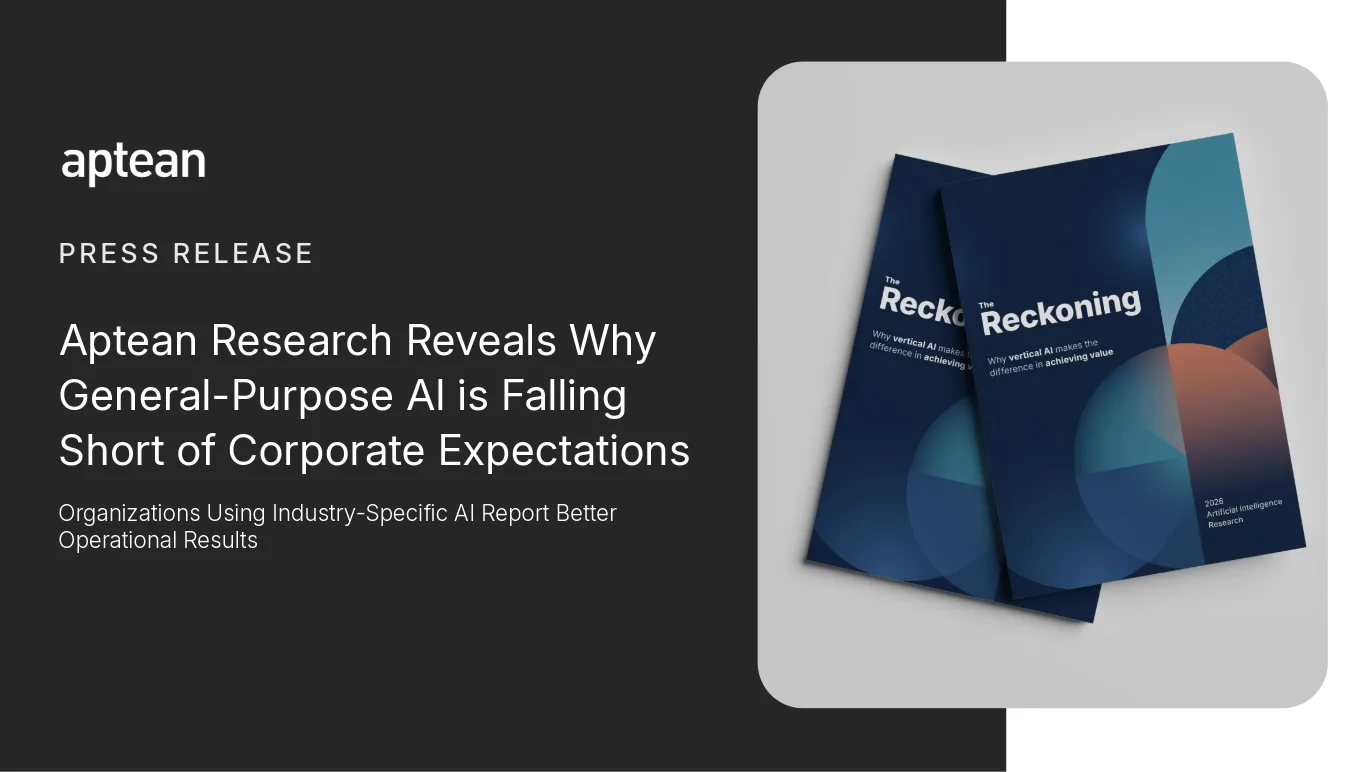
Aptean Research Reveals Why General-Purpose AI is Falling Short of Corporate Expectations
New Aptean research reveals why general-purpose AI models miss the mark for enterprises—and why purpose-built, industry-specific AI delivers real business value.
By Aptean Staff Writer
Share This Press Release
Organizations Using Industry-Specific AI Report Better Operational Results
Alpharetta, GA, July 28, 2026 – One year after an MIT study1 reported 95% of generative AI pilots were failing to deliver measurable value, new international research from Aptean, points to a primary cause: general-purpose AI lacks the relevance and accuracy that businesses demand. The survey also reveals the rise of “Shadow AI” tools, the need for increased governance, and continued optimism for the long-term impact of AI solutions.
The Case for Industry-Specific AI
Aptean's 2026 Artificial Intelligence Research found that over the past year companies using vertical, industry-specific AI outperformed those relying solely on general-purpose tools on seven of eight operational key performance indicators measured. "Seventy-seven percent of leaders told us general-purpose AI simply can't handle the complexity of their operations. That's not a knock on the technology; it's a mismatch of design," TVN Reddy, CEO of Aptean stated. "A generic model doesn't know your business, your compliance rules, or what success looks like in your industry. Purpose-built AI does, and that’s often the difference between success and failure."
Survey respondents clearly stated their desire for vertical AI solutions, purpose-built for a single industry or function and trained on the data, terminology, and compliance rules specific to that domain. 88% of leaders said purpose-built, industry-specific AI is critical or very important to their business. When asked why they preferred industry-specific solutions, the top three reasons cited were easier integration with existing systems, more relevant and accurate outputs, and better strategic guidance from vendors who understand their sector.
The survey identified systems integration as a barrier to AI adoption. Eighty-two percent of respondents said integrating AI with core systems is more difficult than AI technology itself. Most businesses lack this capability in-house and turn to outside vendors for help: 92% of respondents agreed their organization would benefit from external expertise to maximize AI's value, and integration with existing systems ranked as the top factor in vendor selection.
A Call for Governance and Guardrails
After the failure of initial AI pilot programs, many employees elected to bypass company-sanctioned tools in favor of outside AI technologies. The research found 40% of employees using these Shadow AI tools at work without formal approval. This behavior stems from three factors: a gap between employee adoption speed and organizational readiness, a lack of sanctioned tools, and individuals are prioritizing their immediate needs over the organization's governance measures. Despite their own use of Shadow AI, 96% of respondents say a formal AI governance framework — with defined accountability and ethical standards — is necessary, and 75% say the lack of a governance framework is a major barrier to success.
Optimism Endures
Despite early failures and governance gaps, companies remain overwhelmingly optimistic about AI and see it as essential to long-term success. In fact, 83% said opportunity is their primary motivator, and 82% agree AI offers clear value that hasn't been fully realized yet. Rather than reading current failure rates as a reason to pause, respondents see them as a reason to keep investing and gain a competitive advantage.
Read Full Report: The complete findings from Aptean’s 2026 research are available at https://www.aptean.com/en-US/resources/product-capabilities/datasheet/aptean-intelligence-report-the-reckoning.
Data Bank and Resources: Preapproved Language, Statistics and Charts are available for publication at https://www.aptean.com/en-US/ai-statistics-data-bank
1Challapally et al., The GenAI Divide: State of AI in Business 2025, MIT NANDA, July 2025
About this Research
The Aptean 2026 Artificial Intelligence Research is a multi-region study of how organizations are putting artificial intelligence (AI) to work, where it’s paying off, where it isn’t, and why. Aptean commissioned independent research firm Vanson Bourne to survey 1,535 decision-makers at businesses with $10 million or more in annual revenue across six markets (the United States, Canada, the United Kingdom, the Netherlands, France, and Germany) and five industries: food and beverage; apparel and soft goods; transportation and distribution; discrete and process manufacturing; and equipment dealers, plus a cross-sector supply chain cut. Participants were business and IT leaders, from the C-suite to management, with direct involvement in their organization’s AI strategy and influence on decisions relating to enterprise resource planning (ERP) or supply chain management (SCM) systems.
About Aptean
Aptean is an AI company built for industrial business. For medium and enterprise manufacturers, distributors, and wholesalers facing rising costs, shrinking margins, and operational complexity, Aptean embeds AI directly into the workflows, decisions, and data your business already runs on - so intelligence isn't a bolt-on, it's how the work gets done. The result: faster decisions, lower costs, and measurable margin improvement delivered through an ongoing partnership, not a one-off implementation. Headquartered in Alpharetta, Georgia, with offices across North America, Europe, and Asia-Pacific. Learn more at aptean.com.
About Vanson Bourne
Vanson Bourne is an independent specialist in market research for the technology sector. Their reputation for robust and credible research-based analysis is founded upon rigorous research principles and our ability to seek the opinions of senior decision makers across technical and business functions, in all business sectors and all major markets. For more information, visit www.vansonbourne.com.
Media Contact: For translated versions of the research report, please reach out to our media team directly.
North America: Heather Coyle, [email protected]
International: Geraldine O’Neill, [email protected]
General Media Inquiries: [email protected]