
For AI To Impact Healthcare Asset Management, It Needs Quality Data
For AI To Impact Healthcare Asset Management, It Needs Quality Data
For AI To Impact Healthcare Asset Management, It Needs Quality Data
11 Feb 2026
 Aptean Staff Writer
 Key Takeaways From This Blog
Predictive insights are only as accurate as the data they’re built on. To make AI truly effective in healthcare asset management:
Integration is essential: Disconnected systems limit visibility; connected data enables real-time intelligence.
EAM is the foundation: A healthcare EAM platform unifies information from facilities, finance, engineering and clinical systems.
Insight drives strategy: With reliable data, AI can forecast failures, optimise asset lifecycles and guide investment decisions.
Better data, better care: Integrated infrastructure enables proactive maintenance, reduces disruption and supports stronger patient outcomes.

Equipment whispers before it screams. Yet few healthcare facilities can detect these early warning signals—less do something about them.
Artificial intelligence (AI)-powered asset management software can predict and prevent failures before they disrupt operations. But without high-quality data, that AI has nothing to learn from.
Hospital Equipment Failures Are Rarely Random Events
Most healthcare asset management follows a predictable path. Organisations take reactive approaches, fixing equipment after it breaks. Or they use a preventive maintenance programme, relying on fixed rules that don't adapt to changing conditions or asset usage.
But you and I know that hospitals and healthcare facilities are complex, interconnected environments. There’s a “butterfly effect” if something underperforms or fails. A minor HVAC issue can affect theatre sterilisation, and fixing the problem means rearranging surgical schedules, which disrupts patient care pathways.
Equipment failures are rarely random events, and AI enables your healthcare facility to anticipate and therefore prevent them. It connects your physical infrastructure with service operations data, revealing subtle patterns that precede breakdowns.
This early detection turns asset management from basic tracking into strategic decision support. It’s no wonder that 61% of global healthcare leaders are prioritising AI and automation in their operational strategy.
Take that HVAC issue as an example: AI can detect tiny temperature fluctuations imperceptible to people. An engineer can carry out diagnostic work and correct the HVAC fault around surgical schedules, with no impact on theatre availability.
Fragmented Data Hides Critical Warning Signs
AI functions like the human brain, connecting patterns across multiple data sources. It learns from experience and fills knowledge gaps. But like any cognitive system, it's only as good as the information it receives.
For AI to improve healthcare asset management, it needs a foundation most facilities haven’t yet developed—dynamic, integrated data. Just as the brain depends on sensory input to make informed decisions, AI needs continuous data flow from:
Core healthcare CMMS system
Internet of Things (IoT) sensors and monitoring tools
Building management systems
Digital twins of physical infrastructure
Financial and budgetary systems
Supply chain and inventory management
Incident reporting and health and safety systems
Clinical outcomes data
The problem isn’t a shortage of data; it’s fragmentation. According to KPMG, 57% of healthcare facilities say flaws in their foundational enterprise IT systems disrupt operations every week.
Healthcare EAM: The Foundation for AI-Ready Data
A healthcare EAM platform provides the integration backbone AI depends on—connecting facilities, finance, engineering and clinical data into a unified framework.
By merging inputs from Internet of Things (IoT) sensors, building management tools and maintenance systems, an EAM system turns disconnected information into high-quality, structured intelligence that AI can analyse.
With integrated, reliable data in place, AI shifts from theoretical promise to practical value—delivering early warnings, accurate forecasts and clear operational insight.
Three Asset Management Questions AI Should Help You Answer
When you consolidate operational data within a healthcare EAM platform, facilities management moves from educated guesswork to informed foresight. With a single source of truth driving AI insights, you gain clear, evidence-based answers to the questions that shape both clinical performance and financial outcomes.
Here are the three questions your healthcare EAM software should help you answer:
When Will My Asset Fail?
Traditional Computerised Maintenance Management Systems (CMMS) provide static predictions based on equipment manufacturer guidelines. Many fail to account for actual usage patterns, environmental factors and subtle indicators of degradation.
AI-powered healthcare EAM software captures and integrates multiple data streams that humans cannot process fast enough, such as:
Mean time between failures across similar asset classes
Detailed breakdown fault analysis with root cause identification
Installation dates cross-referenced with manufacturer lifecycle data
Condition assessment metrics capturing remaining useful life
Runtime metrics showing actual usage patterns
Historical maintenance effectiveness
By analysing these variables simultaneously, AI can forecast potential asset failures with remarkable accuracy.
Should I Repair or Replace This Asset Now?
Replacing critical equipment is a multi-million-dollar decision. AI’s detailed modelling can calculate the cost to replace equipment versus the ongoing investment needed to make repairs.
An intelligent EAM system will evaluate:
Current warranty status and coverage
Hazard and compliance information
Alignment with planned capital works
Comparative costs of replacement versus ongoing repair
Lead time implications for procurement
Patient care impact during transition
These calculations end the guesswork. Instead, you can prove when an asset crosses the threshold from “worth maintaining” to “ready for replacement”.
How Much Will It Cost to Run My Facility Over the Next Decade?
While clinical roadmaps extend years ahead, healthcare infrastructure planning often remains stubbornly short-sighted. AI increases long-term financial clarity by assessing:
Asset criticality hierarchies (from patient-critical to convenience)
Impact on clinical and non-clinical operations
Potential effects on drug management and supply chain
Revenue implications from service disruptions
Location-based reliability factors
Budget constraint modelling
Risk profile optimisation
This analysis provides confidence that your healthcare asset management strategy is optimised for both financial sustainability and operational excellence.
Everyone Has a Stake in AI-Ready Asset Data
AI-powered asset management doesn’t sit in a data silo. It gives every function in your organisation from finance to facilities, a clearer view of what’s happening, what’s at risk, and what to prioritise.
When asset data becomes decision intelligence, it stops being “just an engineering thing” and starts driving action across your entire organisation.
Senior Executives: AI places maintenance metrics at the heart of boardroom discussions. It pinpoints which preventative actions will safeguard revenue streams and sustain patient scheduling. 55% of healthcare leaders have already identified infrastructure management as an area where generative AI has the greatest potential value, according to McKinsey research.
Facilities Directors: AI analytics eliminate nasty surprises by predicting equipment failures. This intelligence shifts your technical team from constant firefighting mode to proactive planning.
Engineering and Maintenance Leaders: AI delivers irrefutable proof of equipment performance, empowering your team to prioritise critical tasks. Resource allocation also becomes precision-targeted, keeping people focused on high-value maintenance work where their expertise adds value.
Fix Your Data and Better Patient Care Will Follow
Equipment failure is a threat to healthcare service continuity and clinical outcomes. Yet most asset management strategies still rely on reactive fixes.
AI can change this by identifying faults before they cause disruption and forecasting long-term infrastructure needs with a clarity we've never seen before. But only if your data is clean, structured and complete.
Most healthcare providers aren’t AI-ready. Incomplete asset registers, fragmented systems and patchy maintenance histories are still the norm. That’s why most facilities are still spending millions fixing broken equipment and cancelling surgeries for emergency repairs.
AI offers an opportunity to break that cycle. With high-quality data and an integrated EAM foundation, you can anticipate issues before they escalate, optimise asset lifecycles and ensure every operational choice contributes directly to better patient care.
Aptean Healthcare EAM: Improve Your Data Management
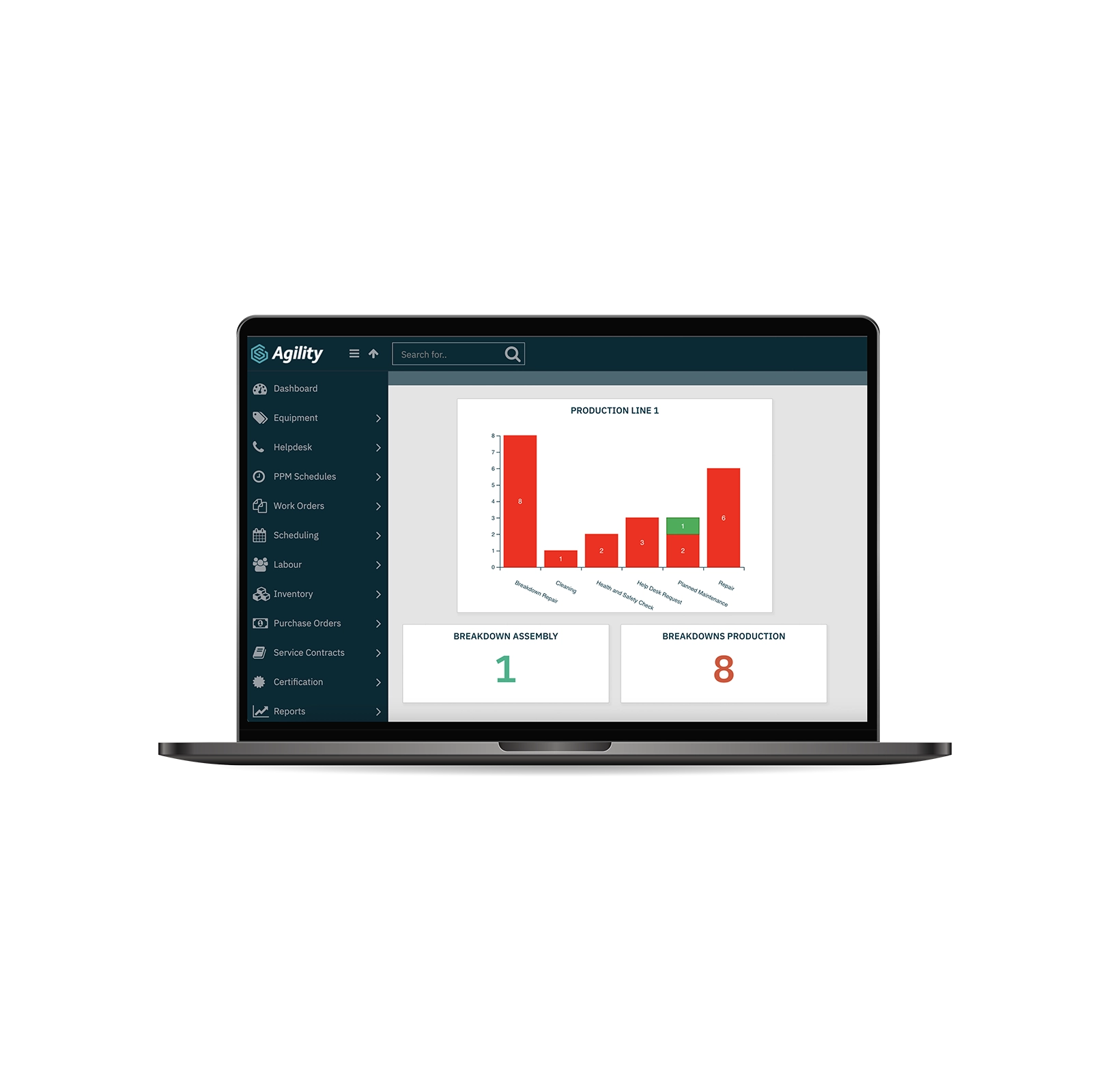
Aptean Agility EAM software consolidates maintenance history, asset condition, compliance records and operational context into a single system, providing the clean, connected data required for reliable AI forecasting and lifecycle analysis.
Information from facilities, engineering and clinical environments is standardised and maintained over time, ensuring AI-based predictions are based on actual performance rather than static assumptions.
This data integrity supports earlier fault detection, clearer repair-versus-replace decisions, and improved long-term planning—enhancing patient care standards across healthcare networks.
Book an initial discovery session with one of our healthcare EAM experts.

Klaar om uw bedrijf naar een hoger niveau te tillen?
We hebben gespecialiseerde EAM-oplossingen waarmee u elke uitdaging in uw branche aankunt.